Get Full Government Meeting Transcripts, Videos, & Alerts Forever!
Get email alerts on the Substance Use Disorder topic
No spam. Unsubscribe anytime.
Health West tells Muskegon County commissioners treatment access improving but local overdose metrics remain concerning
Summary
Health West presenters told Muskegon County commissioners the regional treatment network and access times have improved, but local indicators show higher heroin admissions and a county vulnerability ranking of 14th of 83 in Michigan; presenters outlined a roughly $5.9 million budget and where funds are spent.
Health West officials told the Muskegon County Board of Commissioners on the record that treatment access for people with substance use disorders has improved but that county-level overdose and vulnerability metrics remain troubling.
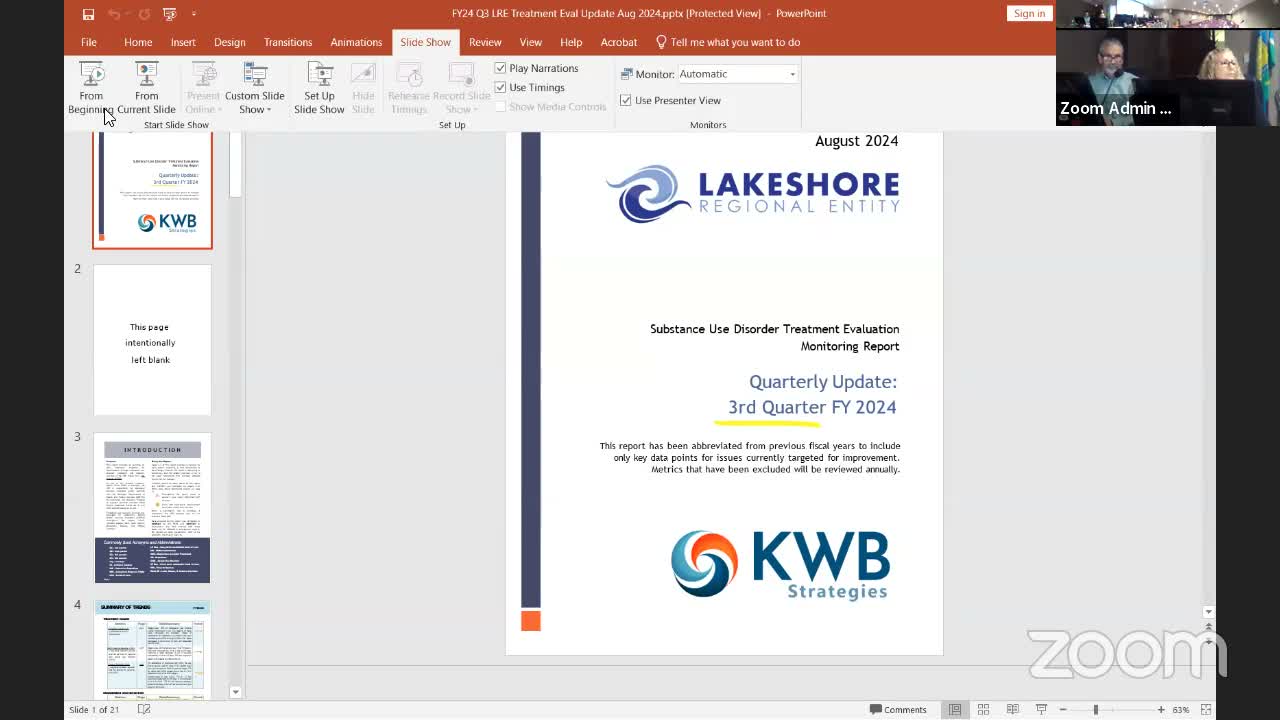
Brandy Carlson, chief financial officer for Health West, and Jennifer Sturm, quality assurance manager for substance abuse treatment, presented the Lakeshore Regional Entity quarterly monitoring report and county-specific metrics. Carlson said readmissions in the third quarter showed "35 percent of admissions had criminal justice involvement," and described reductions in time from request to first service for opioid use disorder — a recent average of 4.7 days after peaking at 8.3 days in an earlier quarter.
The presenters framed the region as well-served by contracted providers but noted service gaps in Muskegon: there are no local residential or detox facilities, so individuals requiring higher-level care are often sent out of county. Sturm said Muskegon County ranks "fourteenth most vulnerable county, out of the 83 in Michigan," on the state vulnerability index while also reporting Muskegon had a higher local share of heroin-related admissions (about 20 percent in the cited quarter) compared with a regional rate of roughly 12 percent.
Sturm described outcomes and capacity metrics the county monitors: of 928 discharges last fiscal year, 46 percent were classified as positive discharges (transfer to another treatment provider or treatment completed), slightly below a commonly cited 50 percent benchmark. Average time to a residential bed was reported at 7.14 days; Sturm noted the state mandate aim is 14 days and said the county is within that requirement but seeks faster access. In the presentation Health West also reported very low 7-, 30- and 90-day readmissions in the tracked windows and said longer-term readmission tracking (180 or 365 days) was not currently performed.
On funding, Sturm said the Health West budget for the year is approximately $5,900,000, with about 82 percent of that paid out to contracted treatment providers and the remaining 18 percent held for direct-run services such as jail treatment, law-enforcement-assisted diversion, recovery coaches and in-house programs. Carlson and Sturm described several recovery supports the county funds, including two opioid treatment (methadone) clinics, three recovery management teams, intensive outpatient and women's specialty services, and recovery housing including a contract with Every Woman's Place.
The presentation prompted commissioners to ask follow-up questions about why people do not always access available services, whether outcome metrics count out-of-county transfers, and whether the county is pursuing more long-term residential care. Health West said out-of-county admissions paid for by Muskegon Medicaid are included in their counts but that sustained long-term residential treatment beyond available program lengths is constrained by Medicaid billing codes; instead Health West funds recovery housing to provide longer-term residential support when appropriate.
The board did not take action on this informational item; Health West presented data and answered commissioners' questions. The most recent procedural step is the board's receipt of the Lakeshore Regional Entity quarterly report and the Health West presentation; commissioners may ask staff for follow-up data or additional tracking (for example longer-term readmission monitoring).