Get Full Government Meeting Transcripts, Videos, & Alerts Forever!
Get email alerts on the Landlord Responsibility topic
No spam. Unsubscribe anytime.
Board tells landlords: eviction timelines don’t excuse long-standing code violations
Summary
At the June 28 hearing the Louisville Metro Code Enforcement Board repeatedly warned that protracted eviction processes do not absolve owners of property-maintenance responsibilities and urged owners to pass remediation costs to noncompliant tenants.
A recurring theme at the Louisville Metro Code Enforcement Board’s June 28 docket was the board’s insistence that owners remain responsible for property maintenance even when tenants are being evicted.
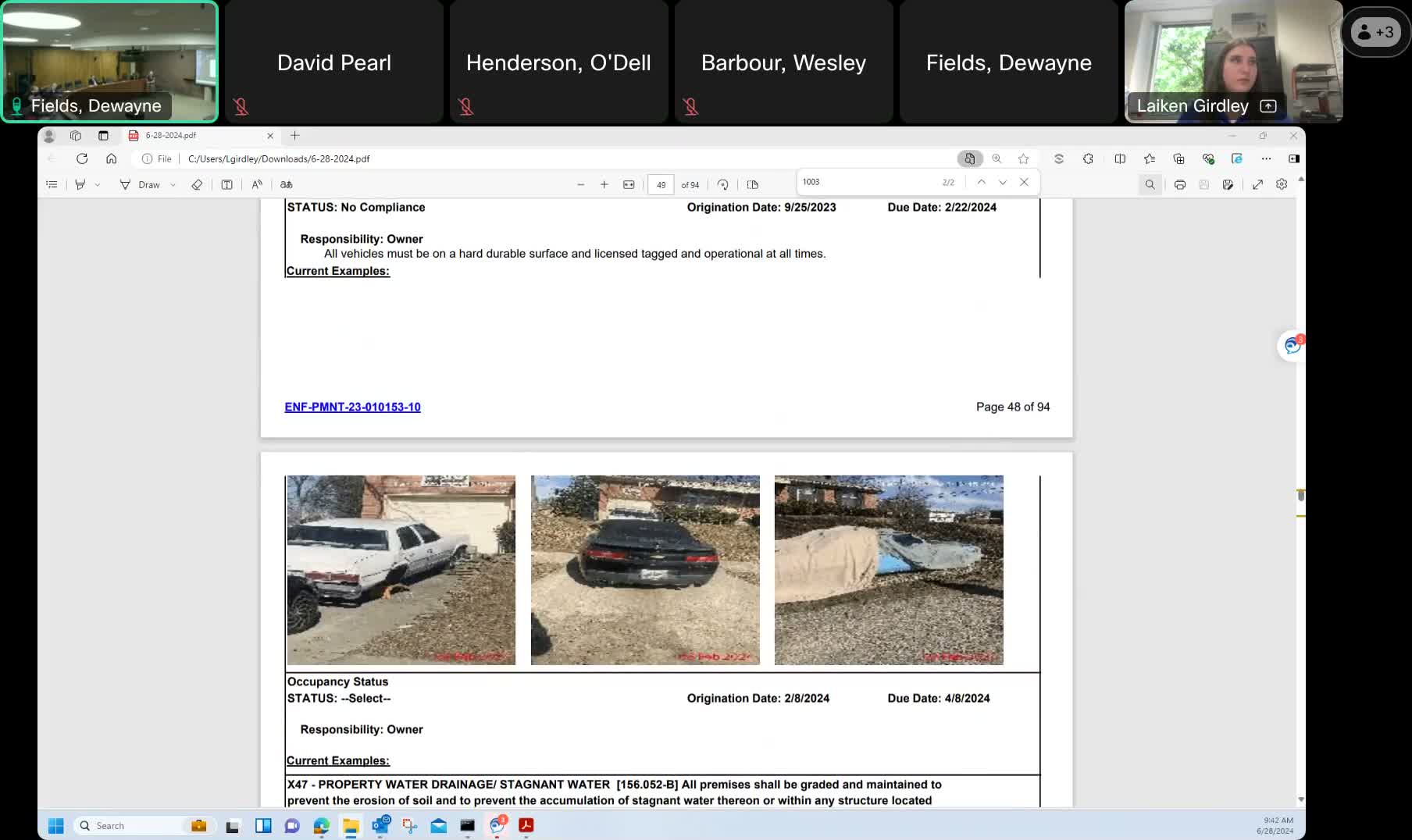
In multiple cases — including 1003 Claiborne Road, 2209 Rowan Street and 963 Brook Street — owners told the board they were pursuing evictions or that tenants had been given notice. The board acknowledged eviction schedules can delay physical control of the property, but members repeatedly said that lengthy waits had not resolved longstanding safety and maintenance hazards.
Assistant county attorney Jason Fowler pressed that Metro should not bear costs that arise from private lease relationships. Fowler argued the board could and should uphold at least a portion of fines so owners feel the fiscal incentive to address violations. In the Claiborne case, where the appellant said a sheriff-set removal was scheduled for July 23, Chair David Pearl said he would “find that the conditions did exist” and—while noting the eviction—moved to uphold penalties with conditional adjustments rather than granting a long continuance.
The board stressed practical options owners have during eviction timelines: coordinate closely with the assigned inspector, document remediation efforts with dated photographs, and, where appropriate, pursue civil remedies against tenants. Pearl advised owners that the inspector may provide flexibility if they proactively communicate progress on cleanup.
What the board will not do, the hearing made clear, is indefinitely delay enforcement when prior inspections show repeated noncompliance. The approach balances enforcement against an acknowledgment of eviction-process realities but leaves the economic burden largely with property owners unless a clear path to tenant liability exists.
The board’s rulings in these landlord-tenant contexts are administrative orders; affected parties were told they may appeal to district court.