Get Full Government Meeting Transcripts, Videos, & Alerts Forever!
Get email alerts on the Walleye Stocking topic
No spam. Unsubscribe anytime.
Nebraska Game and Parks details new walleye stocking strategy, mixed recruitment at Lake McConaughy
Summary
Nebraska Game and Parks Commission said it changed Lake McConaughy's walleye stocking to three developmental stages and has stocked nearly 71 million walleyes since 2022; natural recruitment rose in 2023 but dipped in 2024, and the agency will evaluate the approach through 2026.
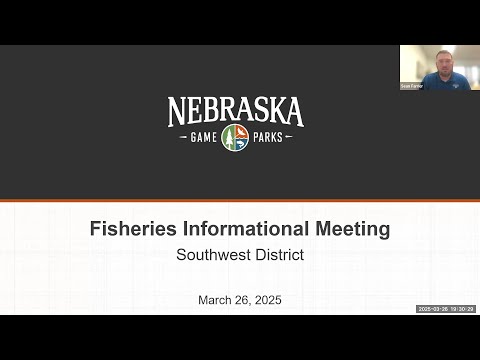
Sean Ferrier, Southwest District Manager for the Nebraska Game and Parks Commission, told anglers the agency changed its Lake McConaughy walleye stocking strategy after concerns about an ageing population and low recruitment.
Ferrier said Game and Parks now stocks walleyes at three developmental stages: "fry at 3 to 5 days old, fingerlings are 1 to 1 and a half inches, and fingerling pluses are 1 and a half to 2 inches." He said the shift began after managers noted a large cohort of older walleyes and a lack of younger fish entering the population.
"So since 2022, we've stocked just short of 71,000,000 walleyes into Lake McConaughey," Ferrier said, and emphasized the scale of the effort across production and management. He added that McConaughy received the majority of the district's stocking in recent years: agency records discussed during the meeting showed roughly 21,000,000 fish stocked there in 2024 and a 2025 request for 24,000,000 of a proposed 32,000,000 statewide allocation for the district.
Early monitoring shows mixed results. Ferrier said fall age-0 surveys historically show 92% to 98% stocked fish, but the agency recorded what it described as greater natural recruitment after the management change: "we saw 12% natural recruitment" in 2022 and "that number bumped all the way up to 22% natural recruitment" in 2023, he said. Survey results in 2024 were lower, and Ferrier cautioned that the agency cannot yet attribute changes definitively to stocking versus natural processes.
Ferrier said survey methods shifted in 2023 and 2024 (placing more gillnets), which may affect catch comparisons, and that the agency plans a five-year evaluation of the new stocking regime. "We're gonna continue this in 2025 and 2026. At that point, we'll evaluate it and decide if we're gonna continue on with this higher number of fry or if we're gonna make some changes," he said.
Agency staff discussed possible environmental drivers for recruitment variation, including a 2022 winter die-off of alewife that may have reduced forage pressure and improved zooplankton quality for young walleyes. Ferrier said staff and research partners at the University of Nebraska at Kearney are monitoring smallmouth and walleye responses to the stocking changes.
The next formal step for the project, Ferrier said, is completion of the multi-year evaluation before any change to stocking plans is made. "We'll only make changes if we deem it necessary," he said.
Ending: The agency said it will continue to publish survey summaries and asked anglers to consult the Game and Parks fishing guide and website for updated sampling reports and forecasts.