Get Full Government Meeting Transcripts, Videos, & Alerts Forever!
Get email alerts on the Public Health topic
No spam. Unsubscribe anytime.
Yuma County public‑health director warns federal funding uncertainty could force program cuts
Summary
Director Diane Gomez told the Board of Supervisors the county’s public‑health operations rely on a mix of local and grant funding (about 52% district funds, roughly 40% federal grants) and that recent stop/restore federal notices threaten community programs such as WIC, maternal‑child services and community immunizations.
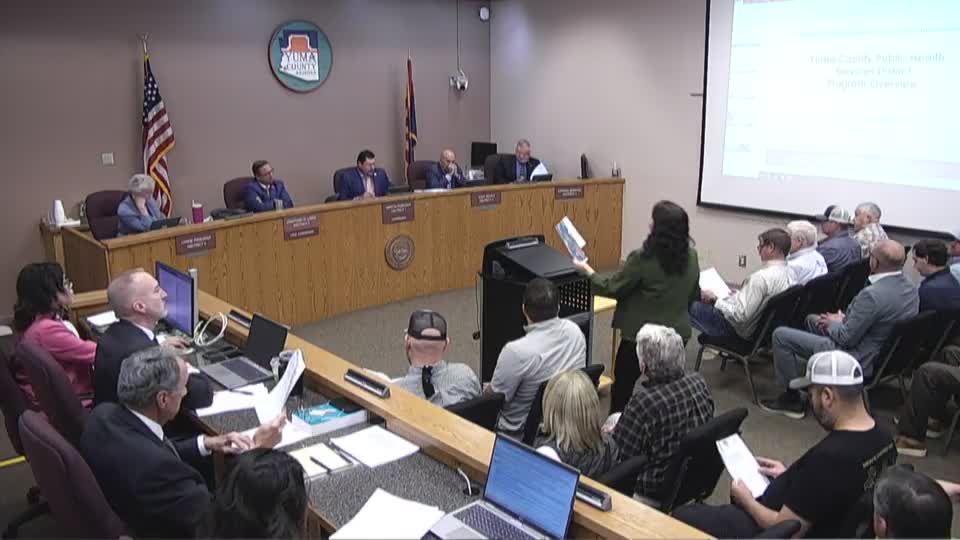
Diane Gomez, director of public health, told the Yuma County Board of Supervisors on March 24 that the county’s public‑health programs are extensive and funding is fragile. The department provides statutorily required services and a wide range of community programs — from birth and death records and WIC to immunization clinics, opioid and suicide fatality review teams, vector control and cooling centers for heat resiliency.
Gomez said the county’s public‑health operations are supported by a combination of district funding and grants: roughly 52% of operations come from district (local) funding and about 40% from federal grants, which often fund community outreach, academic partnerships and maternal‑child programs. She told the board that grant funding comes with a reimbursement model: the department performs work first and requests reimbursement later, which creates liability if grants are paused or rescinded unexpectedly.
‘‘We got a letter that said stop,’’ Gomez said, describing a recent government notice that was reversed days later. ‘‘If we get something that says cease work now, then how are we going to pay people that already did the work?’’
Why it matters: Gomez warned supervisors that losing federal grants would force the department to shrink programming or raise fees that are currently subsidized to keep services affordable. She listed services likely to be affected first — community education, outreach, WIC nutrition support for pregnant women and infants, and many chronic disease programs — and said reduced funding could have ‘‘a very devastating impact’’ on local food‑insecure households.
Board response and next steps: Supervisors pressed for clarity about which programs are grant‑funded and how funding is passed through state and federal channels. Gomez described an ongoing effort to trace funding flows and urged more public discussion of the local impact of state/federal decisions. She said, for now, operations continue and staff are pursuing alternative grants and academic partnerships to reduce reliance on any single funding source.
Gomez also highlighted workforce and service efforts that would be harder to sustain without grants: community immunization events targeting farmworkers, the Health Start prenatal program that follows families for two years, community cooling‑center coordination, the CredibleMinds behavioral health platform available countywide, and a growing medical reserve corps.
What’s next: Gomez said staff will continue current programming while seeking additional grant opportunities and recommended the board consider how to communicate and plan for contingencies if federal funding changes again. The board did not take immediate action during the presentation; supervisors asked staff to provide more detail on funding streams and potential budgetary impacts for future meetings.