Get Full Government Meeting Transcripts, Videos, & Alerts Forever!
Get email alerts on the Towing Fees topic
No spam. Unsubscribe anytime.
Eagle Pass council approves first reading to raise towing and records fees, leaves recovery charges to industry discretion
Summary
On Oct. 15, 2024, the Eagle Pass City Council approved on first reading an ordinance to update Chapter 28 fees for records and towing services, citing that the current $65-per-tow limit is insufficient; council granted fee discretion to the city manager and amended recovery-fee authority to towing companies.
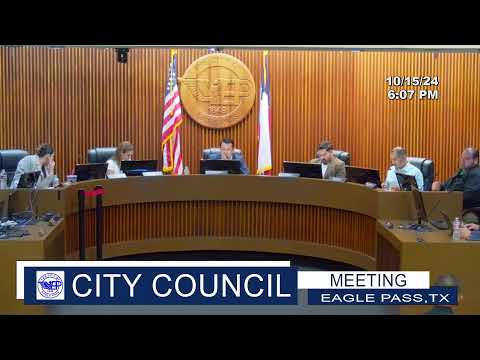
Eagle Pass — The Eagle Pass City Council on Oct. 15 approved on first reading an ordinance to amend Chapter 28 of the city code to update business license requirements and maximum rates for records and towing services, after hearing that the current $65 per tow makes it difficult for wreck‑response businesses to operate.
City staff and the police captain told the council that parts of Chapter 28 dated to 2005 and no longer reflect the costs tow companies face. “At the current, city ordinance rate at $65 a tow, it's merely impossible to run a business,” a staff presenter said during the meeting.
The draft ordinance proposes several changes and leaves some fee amounts to city discretion. Staff said the city had discussed a $500 business license recommendation with the assistant city manager and that record/towing maximums should be raised to reflect market conditions. The draft also lists targeted increases (for example, raising the ordinance maximum for a basic tow from $65 to $75 and increasing certain equipment and service charges), and it notes several storage and impoundment fees that are governed by state rules.
Local towing operators urged the council to preserve flexibility for complex, out‑of‑city recoveries. Gustavo Jimenez III of Tabos Towing described the high costs of modern tow trucks and the labor needed for heavy recoveries, saying crews and specialized equipment only come for adequate pay. “People that have a job aren't gonna come at 02:00 in the morning to unload,” Jimenez said, arguing that fixed low caps would make some recoveries impossible.
Council members debated whether to set minimums or leave extraordinary recovery fees to negotiation. Several members warned that heavy recoveries—such as overturned 18-wheelers—often require extra trucks, forklifts or large crews and may occur off city streets, making fixed caps inappropriate.
Councilman Garcia moved to approve the ordinance on first reading with fee discretion granted to the city manager and an amendment that recovery‑fee amounts for extra extraction work be left to the towing company owners; Councilwoman Cruz seconded. The motion passed unanimously.
What happens next: The ordinance passed its first reading and will return for a second reading where council expects to consider specific discretionary amounts staff may recommend. The city did not adopt final numeric limits at this meeting; some figures remain subject to revision between readings.
Details from the draft ordinance and clarifications provided in the hearing:
- Proposed increase to the ordinance ceiling for a basic tow was discussed as moving from $65 to $75. - Staff said a $500 business license fee for tow companies had been discussed with the assistant city manager as a possible update. - A dolly/specialized equipment fee was recommended to rise from $20 (2005 level) to $45. - The draft lists impoundment and storage items that are governed by state law; staff cited an impoundment figure in the draft and noted state rules control storage fees per day. - Staff and tow‑company representatives proposed a recovery fee rate example of $150 per hour for complex extraction work as a guideline from industry, while council ultimately left those determinations to company discretion in the amendment.
The council's action was a first reading; any final ordinance will be adopted only after the second reading and a final vote.