Westerly ad hoc marina committee outlines reclamation plan, estimates dredging and slip revenue
Loading...
Summary
Doug Brockway, chair of the ad hoc Westerly Marina committee, told the council the 4.35‑acre marina site will need DEM‑required reclamation, may require dredging that could cost roughly $100,000 (or two–three times more depending on contaminants), and could support more than 60 slips generating about $250,000 a year.
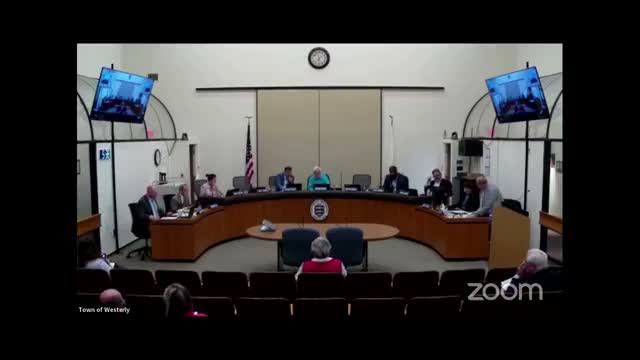
Doug Brockway, chairman of the ad hoc committee on the Westerly Marina, presented the committee’s update and preliminary findings to the Town Council during a special meeting. Brockway said the 4.35‑acre site on the Pocahtuc River, near B and B Dockside and Viking Marina, has mid‑20th‑century fill that contains hydrocarbons and other contaminants and therefore must undergo reclamation under Department of Environmental Management requirements.
"It's 4.35 acres of land," Brockway said, and noted the property had been leased since about 1960 for roughly $17,500 a year. He said the committee asked the town to fund two consulting studies — one on remediation and one on siting and design — and that GZA, the hired consultant, includes an antenna expert to address buried AM radio wiring for station WBLQ.
Brockway said the committee expects GZA to recommend a membrane‑and‑soil remediation approach that would control contaminants without necessarily requiring full excavation of buried AM wiring. He cautioned the remediation and dredging costs remain uncertain: "the dredging might be as little as roughly $100,000" but could be "2, 3 times" higher depending on the material that must be removed. At current market rates he said a reconfigured marina could support more than 60 slips and produce "more than roughly $250,000 a year of revenue to the town from the slips," revenue that would offset a portion of dredging and operating costs.
The committee’s concept calls for replacing the existing, partly dilapidated building with a breakaway ground floor for storage and an upper floor with bathrooms, showers, a meeting room and a manager’s office; Brockway said the design team preferred a flood‑compliant elevator to a long ramp to maximize usable space and ADA compliance.
Residents and councilors pressed the committee on technical points. Councilors asked whether a DEM phase‑2 study had been completed; Brockway and staff said a phase‑1 had been done but a public phase‑2 had not yet been completed. Questions also focused on the WBLQ transmission tower. Town staff confirmed WBLQ owns the tower while the town leases the pad; repairs are WBLQ’s responsibility, but relocating the tower to accommodate redevelopment would be a town expense.
Brockway said the timing for the consulting work includes a public presentation of GZA’s findings planned for Oct. 25, a draft report for town comment in November and a final report in early December; if the committee remains active it will submit a recommendation letter to the council and pursue federal or state grants to cover reclamation, building and dock construction. Town staff are already pursuing permits and preparing to position the town to use any available APA funds.
The presentation closed with council feedback about committee size and governance; Brockway suggested a smaller, task‑focused group could carry out follow‑up work while preserving access to members with specialized knowledge. No formal council action was taken on the marina presentation at the meeting.