Get Full Government Meeting Transcripts, Videos, & Alerts Forever!
Get email alerts on the Stormwater Drainage topic
No spam. Unsubscribe anytime.
Conceptual drainage study finds existing crossings undersized; cost ranges from $430,000 to $2.59 million by location
Summary
Consultants presented a conceptual drainage improvement study for four crossings; none meet the city—s 100-year standard, and options range from box-culvert replacements to large-span bridges with high-level cost estimates between roughly $430,000 and $2.585 million.
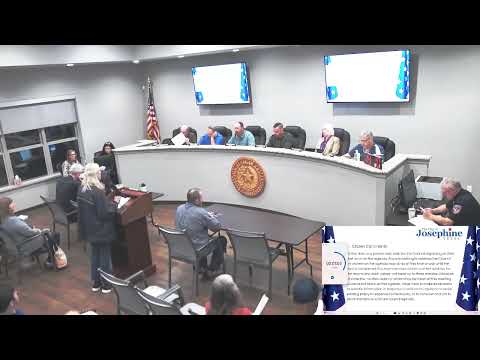
Kimley-Horn engineers presented a conceptual drainage-improvement study to the Josephine City Council on Nov. 12 that found four analyzed crossings currently do not meet the city—s 100-year design standard and offered multiple improvement options with wide cost ranges.
Kate Putsner and Jessica Little described four locations: County Road (CR) 640, Sabine Creek at CR 596, the washed-out Milton Street crossing, and CR 1003 near the water treatment plant. They said the analysis used available LiDAR topography (2019) and record information at a conceptual level and noted that some upstream watershed areas lie outside the city limits, complicating the city—s ability to fully control flows.
For CR 640 the study offered three improvement options with probable construction costs of about $430,000, $465,000 or $640,000 depending on whether roadway lowering and backyard fill were included. For the larger Sabine Creek location at CR 596, options ranged from $1.14 million (roadway improvements plus additional culverts) to $2.585 million (a 95-foot-span bridge plus roadway raising) to achieve higher levels of service including containment of the 100-year existing-condition floodplain. The washed-out Milton Street crossing produced no recommendable vehicular solution because typical fixes would increase upstream water-surface elevations and inundate additional properties; engineers suggested only a pedestrian-grade trail at grade if desired. For CR 1003 the study estimated $480,000—65,000 for culvert replacement with downstream excavation, with the city-owned downstream property making that option feasible.
Kimley-Horn recommended next steps including determining the city—s desired level of service, prioritizing projects for the capital-improvement plan, conducting detailed surveys, and coordinating with county or state entities where watersheds lie outside Josephine—s jurisdiction. The firm also noted it is evaluating a possible stormwater utility as a user-fee funding mechanism.
Council members raised jurisdictional questions (some crossings lie partially in the county), asked about the benefits of cleaning creek vegetation to improve flow, and requested additional permitting and environmental coordination (US Army Corps of Engineers, TCEQ) before design work proceeds. No funding decision was made at the meeting; consultants urged more detailed survey and design work to refine costs and impacts.