Get Full Government Meeting Transcripts, Videos, & Alerts Forever!
Get email alerts on the Committee Hearing topic
No spam. Unsubscribe anytime.
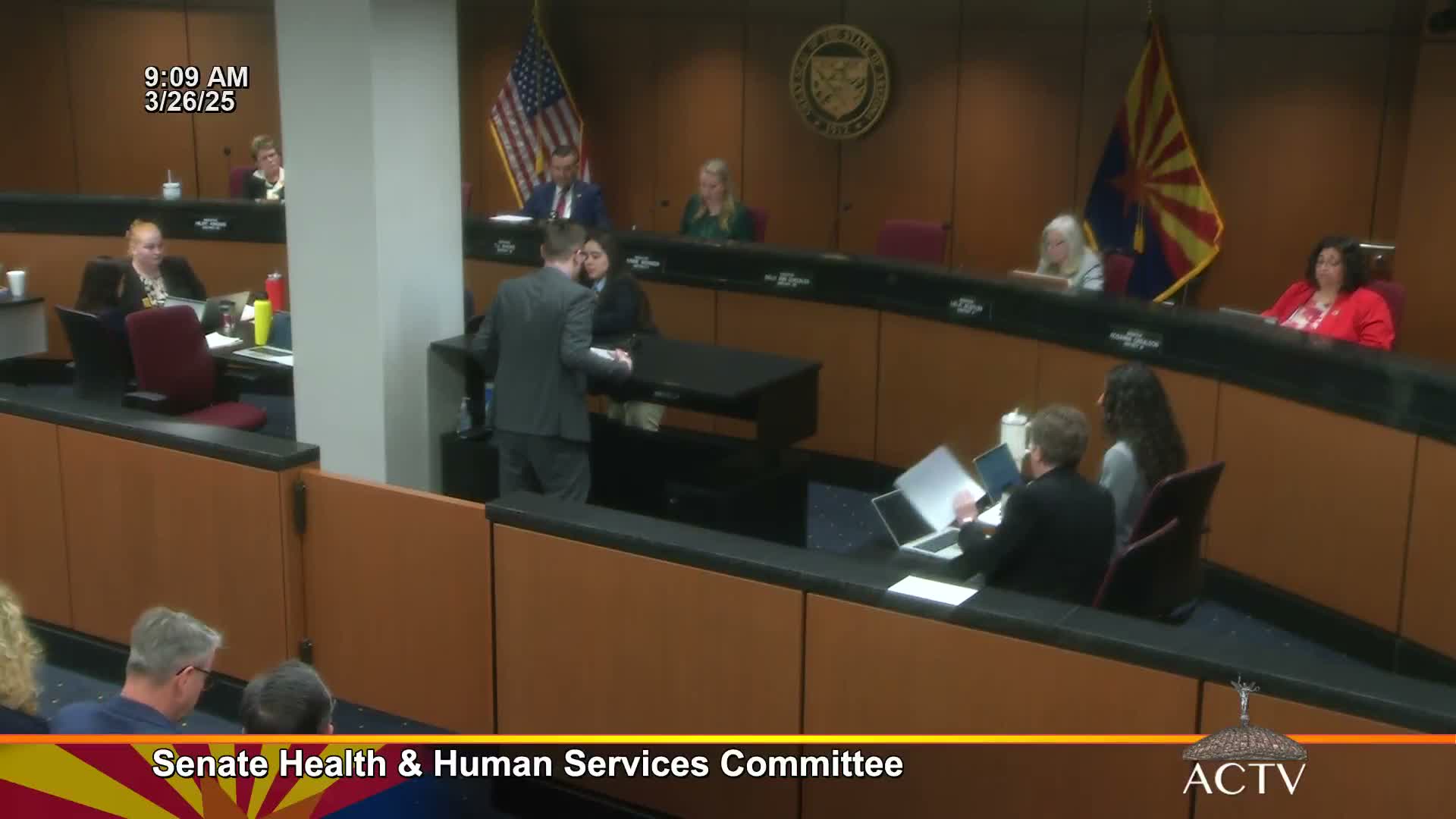
Senate health committee advances foster, telehealth, first-aid and mental-health bills; assisted‑living camera bill fails
Summary
The Senate Health and Human Services Committee heard hours of testimony on multiple bills March 24, failing to advance HB 2,785 (electronic monitoring in assisted-living) and giving do-pass recommendations to HB 2,257 (foster placement regardless of household vaccination status), HB 2,434 (rural telemedicine interoperability grant), HB 2,052 (first-aid licensure exemption), and HB 2,706 (intensive treatment services with funding limits).
The Senate Health and Human Services Committee of Reference on March 24 considered a package of public‑health and human‑services bills, rejecting a proposal to require facilities that receive public funds to allow in‑room electronic monitoring and moving forward several other measures involving foster placements, rural telemedicine grants, limited first‑aid exemptions and court‑ordered intensive treatment services.
The most contentious item, House Bill 2,785, would have barred assisted‑living facilities and nursing homes that accept public monies from prohibiting residents from installing monitoring devices in their private rooms and authorized the Department of Health Services to levy civil penalties for violations. Representative Winn, who spoke in support, recounted family experiences and agency complaint totals, saying the bill is about residents’ ‘‘peace of mind’’ and protection. ‘‘They beat me,’’ Winn said recounting his late father’s claim of abuse, and cited 6,740 long‑term‑care complaints received by DHS in fiscal 2024 as evidence that monitoring can help expose wrongdoing and protect both residents and staff.
Opponents — including Arizona Leading Age, the Arizona Assisted Living Home Association and some providers — argued cameras would erode resident dignity, intrude on privacy during intimate care, increase costs and create practical and HIPAA‑related problems, particularly in small homes. ‘‘This bill forces a loss of dignity and privacy,’’ Marie Isaacson told the committee, adding that residents often need help with toileting and bathing and that surveillance could be humiliating.
After stakeholder testimony and extended questioning about consent, who would access recordings, and workforce consequences, a motion to give HB 2,785 a do‑pass recommendation failed on roll call (1 aye, 5 noes). Several senators said the question raised important tradeoffs between resident safety and staff privacy and recommended additional study.
Votes at a glance
- HB 2,785 (electronic monitoring, assisted living/nursing homes): Motion to give a do‑pass recommendation failed; committee vote 1 aye, 5 noes (failed in committee). - HB 2,257 (prohibiting DCS from denying placement based solely on household vaccination status): Committee returned a do‑pass recommendation (4 ayes, 3 noes). Supporters — including long‑time foster parents — said the law currently prevents many qualified homes from accepting young children; opponents warned about infection risks for infants and toddlers. - HB 2,434 (strike‑everything amendment; ADOA grant for interoperability software): Amendment adopted; due‑pass recommendation carried (6 ayes, 1 no). Sponsors and vendor witnesses said a single interoperable, smartphone‑native solution has reduced physician response time from hours to minutes in pilot sites and can reduce unnecessary transports and duplicated imaging. - HB 2,052 (limited first‑aid exemption for uncompensated, good‑faith care): Do‑pass recommendation carried (6 ayes, 1 no). Supporters described street‑level first‑aid programs that treat wounds and prevent infections among people experiencing homelessness. - HB 2,706 (court orders for intensive treatment services for some people with severe, treatment‑resistant mental illness), as amended to limit orders to services with identified funding: Amendment adopted; due‑pass recommendation carried (7 ayes, 0 no). Testimony included family members seeking more effective court‑ordered wraparound services and civil‑liberties groups urging careful drafting to protect due process.
Why the committee split on cameras
Supporters of HB 2,785 argued cameras are a practical tool to deter and document abuse and to exonerate staff in false‑accusation disputes. Stuart Goodman and Brendan Blake (AARP) and family members cited examples where recording revealed abuse and called the bill a choice for residents, not a mandate on facilities. Opponents countered that recording intimate care would harm dignity, could capture private medical care or roommates, and would be impractical for small facilities to manage. Witnesses also raised cybersecurity concerns for Wi‑Fi‑enabled cameras and the possibility that family pressure could coerce residents into consenting.
Foster placements and vaccinations
HB 2,257 prompted a large turnout of foster parents and prospective foster families. Supporters, including sponsor Lisa Fink and several foster parents, said that under current policy some licensed homes are barred from accepting children under age 5 because a household member is not fully vaccinated, reducing placement options and splitting sibling groups. Opponents, including public‑health organizations, urged caution for infants and toddlers with developing immune systems and urged maintaining a preference for vaccinated households for the youngest children. The committee ultimately issued a do‑pass recommendation.
Telemedicine and rural hospitals
Lawmakers advanced HB 2,434 after adopting a strike‑everything amendment. Representative Matt Gress and vendor witnesses described a program in pilot counties that uses an interoperable, HIPAA‑compliant smartphone app to let receiving‑site physicians view DICOM images and medical records before transfer; Dr. Gregory Grant told the committee the system has been used hundreds of thousands of times in pilot work and reduced clinician response time ‘‘from 3 hours to 7 minutes,’’ helping avoid some transfers and repeated imaging.
First‑aid exemptions and mental‑health services
HB 2,052 exempts basic, good‑faith first aid from licensure penalties; witnesses representing outreach groups said the bill fills a gap not covered by the Good Samaritan immunity and protects volunteers who treat wounds, provide bandaging and offer OTC remedies in community outreach. HB 2,706 — amended to limit orders to services with identified funding — was advanced after significant testimony from families and providers about the need for court‑ordered wraparound services for certain chronically treatment‑resistant individuals, and after civil‑liberties groups urged careful drafting to preserve due process and to clarify costs and procedural safeguards.
What’s next
Bills that received do‑pass recommendations will be scheduled for floor consideration according to the Senate calendar; the failed electronic‑monitoring proposal may be reworked in light of committee concerns about consent, privacy and small‑home burdens. The committee closed with brief consideration of continuation bills for state licensing boards and then adjourned.
Speakers quoted in this report were present in the committee hearing transcript and were identified by the committee or themselves during testimony.