Get Full Government Meeting Transcripts, Videos, & Alerts Forever!
Get email alerts on the Surplus Tax Formula topic
No spam. Unsubscribe anytime.
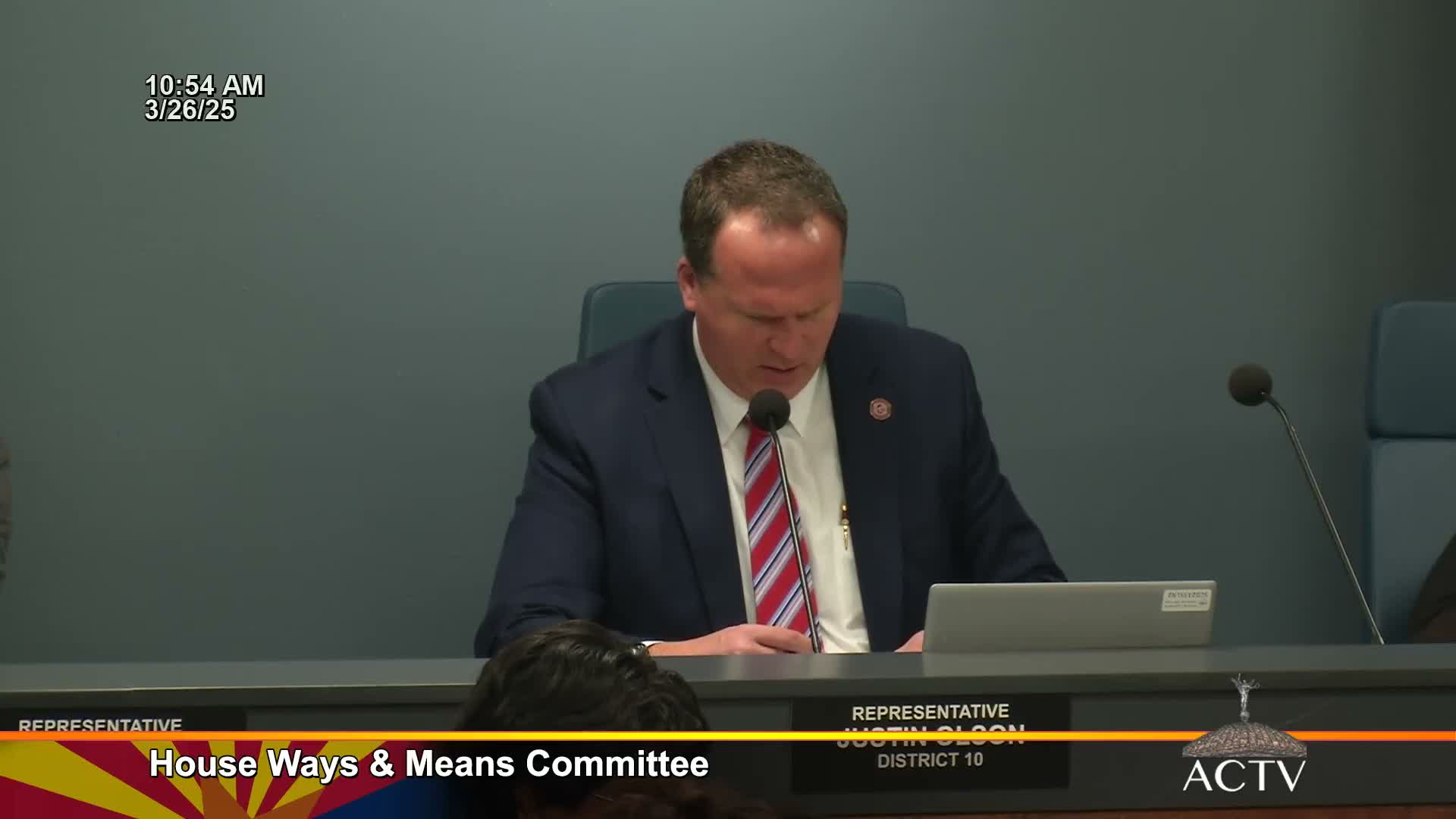
Committee advances SB1318 after debate over automatic surplus tax cuts
Summary
The committee voted to return SB1318 with a due-pass recommendation after testimony from municipal groups and economists warning that automatic income-tax reductions tied to a surplus formula could undermine city revenue and planning; sponsor defended guardrails and rainy-day funds.
The House Ways and Means Committee returned SB1318 (and companion SCR1014) with a due-pass recommendation after an extensive discussion about whether automatic, formula-based reductions in the individual income-tax rate would create instability for state and local budgets.
Staff explained SB1318 would direct the Joint Legislative Budget Committee to identify state-fund revenue metrics and require the Department of Revenue to reduce the individual income-tax rate by 50% of the structural surplus, beginning in tax year 2026. Sponsor testimony described the design as a measured approach that returns half of an ongoing surplus to taxpayers, with triggers that account for population growth and inflation.
Opponents, including Tom Savage of the League of Arizona Cities and Towns, told the committee automatic triggers would prevent a deliberate legislative assessment of fiscal impacts and could harm city budgets because urban revenue sharing is tied to state income tax collections. "These automatic reductions occur without an assessment of potential fiscal impacts," Savage said, urging caution.
Joseph Palomino of the Arizona Center for Economic Progress argued distributional effects matter: illustrative modeling showed potential large revenue reductions with benefits skewed to higher-income taxpayers while the state still faces structural needs in schools, childcare, and infrastructure. Supporters and the sponsor responded that the bill uses a historical high-water mark and guardrails, and that the state has a large budget stabilization fund to handle downturns.
Committee members debated the Colorado TABOR comparison and whether automatic mechanisms would force future spending cuts or special exceptions. The sponsor and several members emphasized safeguards: the measure uses ongoing (not one-time) surplus calculations, accounts for population and inflation, and is not designed to ratchet down spending in a way that makes recovery impossible.
After questions and discussion, the committee voted to return SB1318 with a due-pass recommendation. Members asked JLBC and DOR to provide clearer fiscal modeling ahead of floor action and acknowledged they would seek additional clarifications about the mechanics of the triggers and the interplay with existing budget rules.
The committee also returned the companion Senate concurrent resolution (SCR1014) that would place the question before voters if needed.