Get Full Government Meeting Transcripts, Videos, & Alerts Forever!
Get email alerts on the Tax Credits Qco Qfco topic
No spam. Unsubscribe anytime.
Stakeholders urge changes to SB1496 to protect foster-focused tax credits
Summary
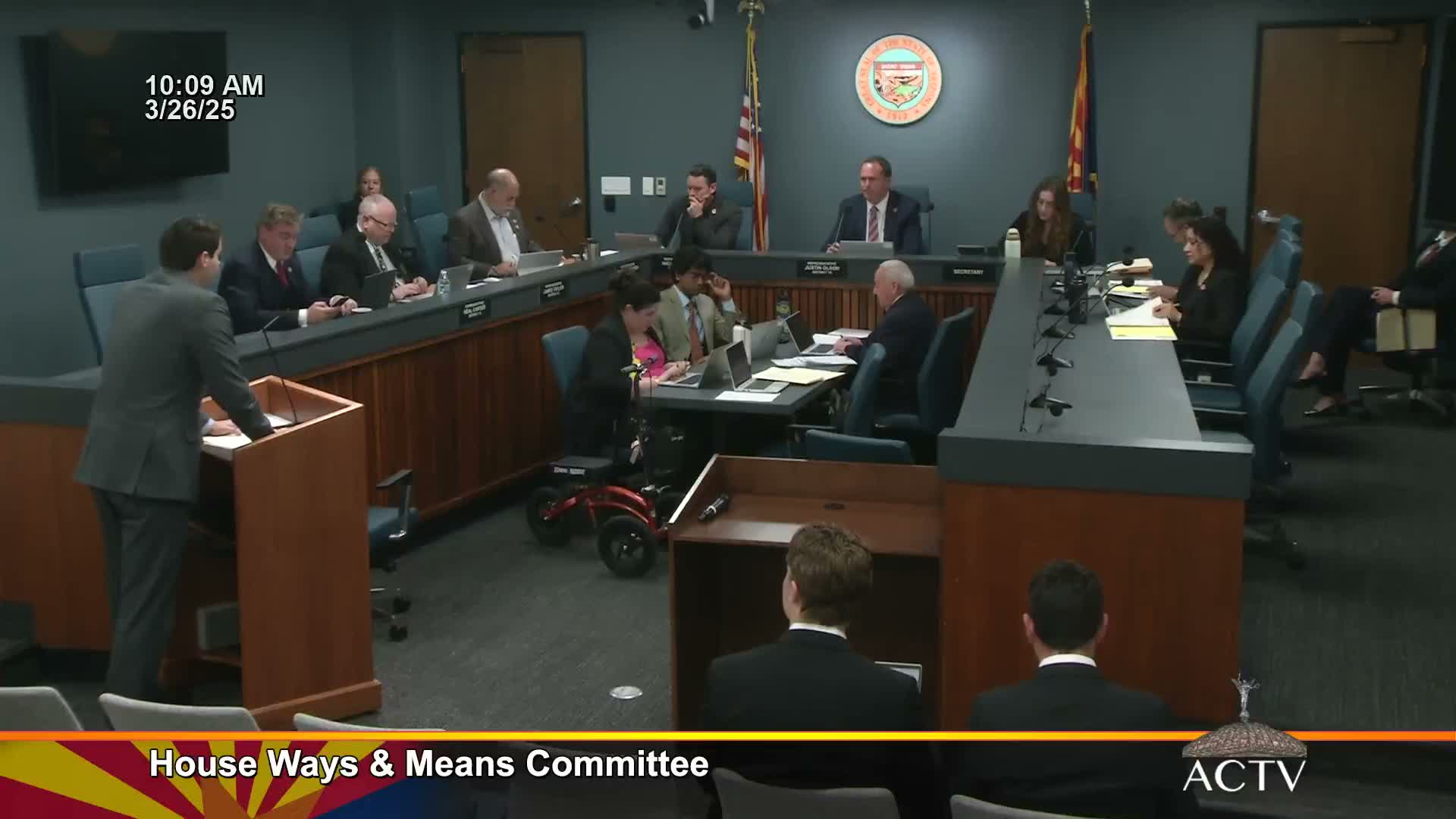
During a House Ways & Means hearing, sponsors and stakeholders debated SB1496, a bill to clarify who qualifies for Arizona's qualifying charitable organization tax credit. Foster-care providers warned the bill could reduce funding to small, specialized organizations; sponsors agreed to stakeholder meetings and signaled willingness to craft floor amendments.
A House Ways and Means Committee hearing on SB1496 on the qualifying charitable organization (QCO) and qualifying foster care charitable organization (QFCO) tax credits produced a pledge from the bill sponsor to work with affected groups after several speakers raised concerns that the draft could unintentionally shift funding away from small foster-care charities.
Research intern Douglas Dexter opened the discussion, saying the bill "modifies the definition of services pertaining to individual income tax credits for charitable qualifying charitable organizations" and would create a single definition of services covering both QCOs and QFCOs. Sponsor testimony framed the measure as a cleanup intended to address a Department of Revenue (DOR) reinterpretation.
Mark Osborne, testifying for the Delta Dental Foundation, said the foundation historically qualified as a QCO by directing funds to service providers and that DOR's guidance changed that practice. "They basically said, wait ... you will no longer qualify," Osborne said, urging legislative action to restore the previous outcome for pass-through funders.
Brandy Petrone of Givens Schwartz, representing AZ Impact for Good, described a multi-year stakeholder process with DOR to standardize guidance. Petrone said the finalized guidance caused some organizations to "fall off" the qualifying list and that SB1496 aims to prevent that while noting the statute holds both credits side-by-side, which complicates drafting.
Danica Robinson, president and co-founder of ASA Now and a licensed foster parent, testified she was "here today to testify against SB1496 in its current form." Robinson said QFCOs are far smaller and provide specialized services for children impacted by foster care; she warned that expanding the list of eligible services or allowing umbrella organizations to act as pass-throughs could dilute funds for QFCOs. Robinson listed four concerns in the bill text: minimum-service requirements, umbrella organizations that might retain donations, expansion of services to nonfoster-focused QCOs, and a lack of clear fiscal analysis.
Molly Murphy of the Department of Revenue confirmed DOR worked with stakeholders and provided technical feedback, and said the guidance that followed the stakeholder process led the department to conclude that organizations that merely direct funds should not qualify as QCOs under the current guidance. Murphy said the proposed statutory change would allow directing organizations to qualify, but the agency "has no policy stance on whether or not they should or shouldn't."
Committee members pressed for numbers and fiscal clarity. Petrone said the fiscal impact is difficult to estimate but gave context: the majority of qualifying charitable organizations (about 70 percent of the roughly 1,200 QCOs) had average contributions near $23,891 and that in 2024 Arizona taxpayers claimed about $84 million in QCO credits. Robinson and others urged more detailed analysis on effects for the 58 QFCOs that serve foster children.
The chair and sponsor repeatedly said the intent was not to harm QFCOs, and the sponsor offered to work with QFCO representatives, AZ Impact for Good, Delta Dental, and DOR to craft a floor amendment. After that commitment and public testimony, the committee voted to return SB1496 with a due-pass recommendation.
The sponsor and affected groups are expected to meet before floor action to attempt to finalize language that preserves targeted foster-care funding while resolving the statutory ambiguity.
The committee recorded SB1496 as returned with a due-pass recommendation; the chair invited post-hearing stakeholder meetings before any floor amendment is offered.