Get Full Government Meeting Transcripts, Videos, & Alerts Forever!
Get email alerts on the DEI Policy topic
No spam. Unsubscribe anytime.
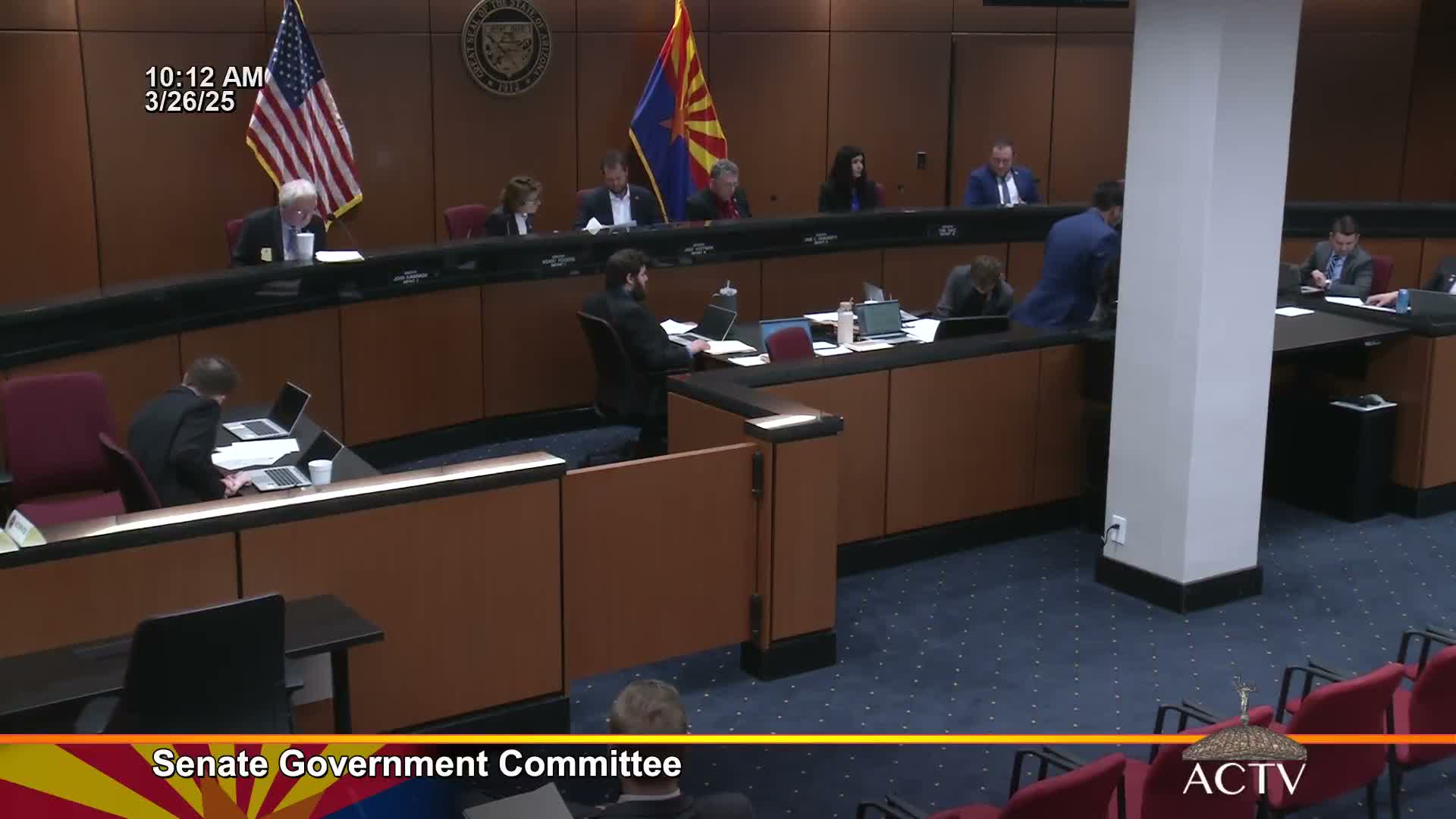
Senate committee advances amended ban on DEI offices after heated debate
Summary
The Arizona Senate Committee on Government voted 4–3 on March 25, 2025, to give House Bill 2,868 a due‑pass recommendation after adopting a strike‑everything amendment that restricts state and local DEI offices and requires disciplinary policies for violations. The bill drew extended questioning and opposing testimony from civil‑rights advocates who warned of legal and equity consequences.
The Arizona Senate Committee on Government on March 25 advanced an amended version of House Bill 2,868 that would curb diversity, equity and inclusion programs across state and local government, community colleges and state universities.
Under a 10‑page strike‑everything amendment explained by staff, HB 2,868 would prohibit specified state entities from establishing or maintaining DEI offices, hiring or contracting for DEI duties, compelling DEI statements, or giving preferential treatment based on DEI statements. The amendment also adds reporting and certification requirements for community colleges and state universities before certain appropriated funds may be expended. A subsequent two‑page amendment in the chairman’s name modifies enforcement language to require adopting disciplinary policies for employees or contractors who violate the bill’s prohibitions.
Supporters said the bill restores equal treatment and prevents what they described as outcome‑focused policies. Representative Wei, sponsor of the House measure and appearing in the committee, told senators the proposal ‘‘emphasizes the importance of equal treatment under the law’’ and said it is intended to prevent ‘‘reverse discrimination.’’ Brian Sickma of Do No Harm testified in favor, saying DEI has led to practices that undermine merit and that the state should avoid potential federal funding conflicts.
Opponents warned the bill would erase tools used to address systemic inequality and trigger litigation. Harrison Redmond, testifying for the ACLU of Arizona, said HB 2,868 ‘‘would prohibit vital diversity, equity, and inclusion initiatives that have worked well to ensure fairness and opportunity for all Arizonans’’ and urged a no vote. Committee questioning repeatedly returned to whether the measure would conflict with federal civil‑rights statutes or prompt costly lawsuits; proponents answered that the bill is narrowly framed and would not negate existing federal protections.
Senators exchanged sharp questions about the real‑world effect of DEI programs, frequently citing the U.S. Supreme Court’s Students for Fair Admissions v. Harvard decision while disputing whether that case controls hiring, training or contracting practices. Several senators offered personal explanations of their votes on the record, citing differing views on whether DEI practices promote opportunity or unfairly advantage particular groups.
The committee adopted the strike‑everything amendment and additional edits, then voted 4–3 to give HB 2,868 a due‑pass recommendation as amended. The committee record shows the matter will proceed to floor consideration with the adopted amendments as the committee’s recommendation.
The next procedural step is consideration by the full Senate, where further amendment, debate or a final vote may occur. At the committee hearing, witnesses and senators both signaled that legal counsel and stakeholders will continue to review the bill’s scope and potential federal‑law conflicts.