Get Full Government Meeting Transcripts, Videos, & Alerts Forever!
Get email alerts on the Education topic
No spam. Unsubscribe anytime.
House Education Committee advances package of bills on school health, background checks, adult education and extracurricular access
Summary
The House Education Committee advanced a suite of bills during its final 2025 session, including measures requiring schools to disclose health‑office staff credentials on parental request, expanding fingerprint‑clearance oversight of classified staff, restoring adult‑education funding, permitting private/ESA students to try out for public activities, and clarifying NIL rules for universities.
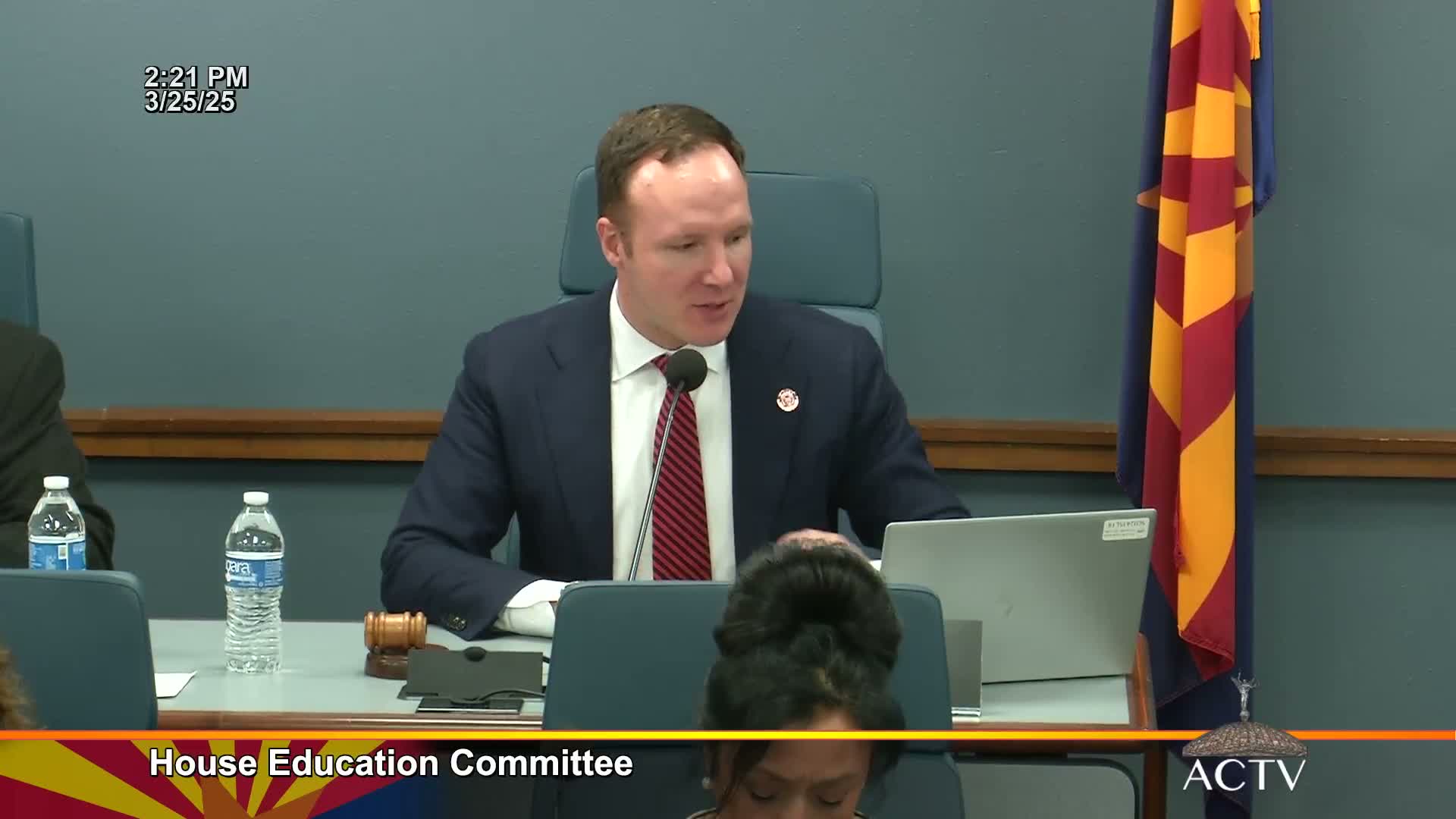
The House Education Committee concluded its final 2025 meeting by advancing a broad package of bills on school health transparency, personnel screening and accountability, adult education funding, extracurricular eligibility, and other education matters.
Senate Bill 13-83: school health credentials Senate Bill 13‑83, brought by Senator Epstein, would require a school district or charter school that provides routine health services in a school health office to provide, upon parental request, the healthcare credentials of each individual who provides such services and to explain the types of emergency‑response training required for employees. Julie Lazara and Mark De April testified that they lost their son Landon after an on‑campus medical emergency and urged lawmakers to approve the bill. Lisa Alexander, a nationally certified school nurse and president of the School Nurse Organization of Arizona, described cases where unlicensed staff are colloquially called “nurses” and said the bill is a first step toward transparency. Committee members asked whether CPR training is already required; sponsors said statewide teacher‑certification requirements do not uniformly impose CPR for all staff and the bill would ensure parental access to credentials. The committee gave SB 13‑83 a due‑pass recommendation (recorded as 12 ayes, 0 no's).
Senate Bill 12‑92: fingerprint clearance and SBE jurisdiction Senate Bill 12‑92 would expand the State Board of Education’s (SBE) jurisdiction to investigate non‑certificated staff who provide services directly to students and remove the exemption for classified staff supervised by certificated employees so more staff must obtain IVP fingerprint clearance cards. The bill conditions enactment on a $1.2 million FY26 appropriation to the State Board to hire investigators and related staff. Supporters — including Senator Warner, Rebecca Beebe of Arizona School Administrators, and parents of students with disabilities — said the measure closes a gap that allowed some people with substantiated misconduct to move between schools or work in other child‑facing settings. Committee members pressed SBE and stakeholders on how the fingerprint‑clearance card system would be tracked and on the cost burdens borne by classified staff; SBE staff said the $1.2M is to fund investigators and adjudicatory capacity, while the card fee itself is typically charged to applicants or districts. The committee returned the bill with a due‑pass recommendation.
Senate Bill 10‑84: adult education funding and administrative changes Senate Bill 10‑84 (an emergency measure) would continue three adult‑education programs and appropriate $18 million in FY26 ($6M to each program) while changing reporting, residency and per‑student funding caps; a Gress amendment adjusted residency verification, reporting requirements and per‑student limits. Testimony from Pima Community College and the Excel Center/Goodwill emphasized adult education’s role in workforce preparation and noted large numbers of working‑age adults without a diploma. ADE explained prior administrative and invoicing problems with program management and supported the amendment’s administrative clarifications. The committee adopted the amendment and returned the bill with a due‑pass recommendation as amended.
Senate Bill 16‑93: private/ESA students and participation in public activities Senate Bill 16‑93 would require public schools to allow private‑school students who reside in the district attendance area (including most ESA‑funded students) to try out for interscholastic activities, with pro‑rata participation fees and academic verification. Sponsor testimony stressed inclusion and preventing students from being excluded from activities; opposition from the Arizona Interscholastic Association and district administrators raised concerns about team capacity, local control, “micro‑schools” created to game athletic rosters, and fairness to students enrolled in the public school. The committee debated a Gress amendment, considered possible carve‑outs for students with disabilities and verification mechanics, and ultimately advanced the bill with a due‑pass recommendation (7 ayes, 5 no's). Members urged further drafting work on verification and capacity issues before floor action.
Other bills advanced - SB 14‑93 (DCS caseworker school ID): requires DCS caseworkers to present DCS identification when interviewing students at schools and establishes a verification pathway; ADE and DCS reported ongoing work on an amendment that would limit storage of personal IDs. Due pass recommendation recorded. - SB 14‑70 (special education): allows an IEP team to extend services through the end of the school year in which a student turns 22 and seeks to prevent ADE penalties for extended services; parents and advocates supported the bill; committee returned it with a due‑pass recommendation. ADE and JLBC provided preliminary fiscal notes estimating possible enrollment and aid impacts; numbers are approximations. - SB 16‑59 (SBE disclosures to hiring officials): permits a high‑ranking school official to request SBE information about unresolved investigations if a candidate resigned before SBE action; sponsors tied the bill to prior reforms ("Ava's Law"). Due pass recommendation recorded. - SB 16‑15 (NIL rules for postsecondary): clarifies name‑image‑likeness rules for student athletes, allows universities to partner with tax‑exempt marketing entities and fundraising mechanisms (including a 50/50 raffle model described in committee) to support athlete compensation, and limits institutions from rostering or punishing athletes based on NIL activity; universities testified in favor; committee adopted clarifying amendments and returned the bill with a due‑pass recommendation. - SB 14‑72 (three‑year school budgets): would require districts to prepare three‑year budgets with enrollment projections and enrollment‑change rates. Committee debate was lengthy: proponents called it good business practice, opponents argued the Legislature’s own budget timing and federal funding uncertainty make multiyear mandates difficult without stakeholder work; the committee advanced the bill 7–5. - SB 15‑03 (School Facilities Oversight Board continuation): continues SFOB to 2030, adds employee disclosure requirements and clarifies the SFOB estimate process; amendment adopted and the bill advanced.
Votes at a glance (committee floor recommendations) - SB 13‑83 — due pass recommendation (reported 12 ayes, 0 no's). - SB 12‑92 — due pass recommendation (roll‑call recorded in meeting). - SB 10‑84 as amended — due pass recommendation as amended. - SB 16‑93 — due pass recommendation (committee vote 7 ayes, 5 no's). - SB 14‑93 — due pass recommendation. - SB 14‑70 — due pass recommendation. - SB 16‑59 — due pass recommendation (11 ayes, 0 no's, 1 absent noted). - SB 16‑15 as amended — due pass recommendation (11 ayes, 1 no noted in committee record). - SB 14‑72 — due pass recommendation (7 ayes, 5 no's). - SB 15‑03 as amended — due pass recommendation (10 ayes, 2 no's recorded).
What matters for the public The committee’s actions tighten transparency about who provides medical care to students, extend oversight and tracking of classified staff who work with children, preserve and reauthorize adult‐education funds, and address access to school extracurricular activities and postsecondary athlete compensation. Several members and witnesses asked for clearer fiscal estimates or further stakeholder work — notably on fingerprint‑clearance mechanics, the fiscal impact and administration of expanded SBE jurisdiction, and how schools will verify eligibility and preserve team capacity if private or ESA‑funded students can try out for public‑school teams.
Next steps Each bill advanced to the House floor for further consideration; sponsors and stakeholders signaled they may refine language before floor votes, especially for items that raised fiscal or implementation questions. The committee adjourned after brief farewells to staff.