Get Full Government Meeting Transcripts, Videos, & Alerts Forever!
Get email alerts on the Fuel Regulation topic
No spam. Unsubscribe anytime.
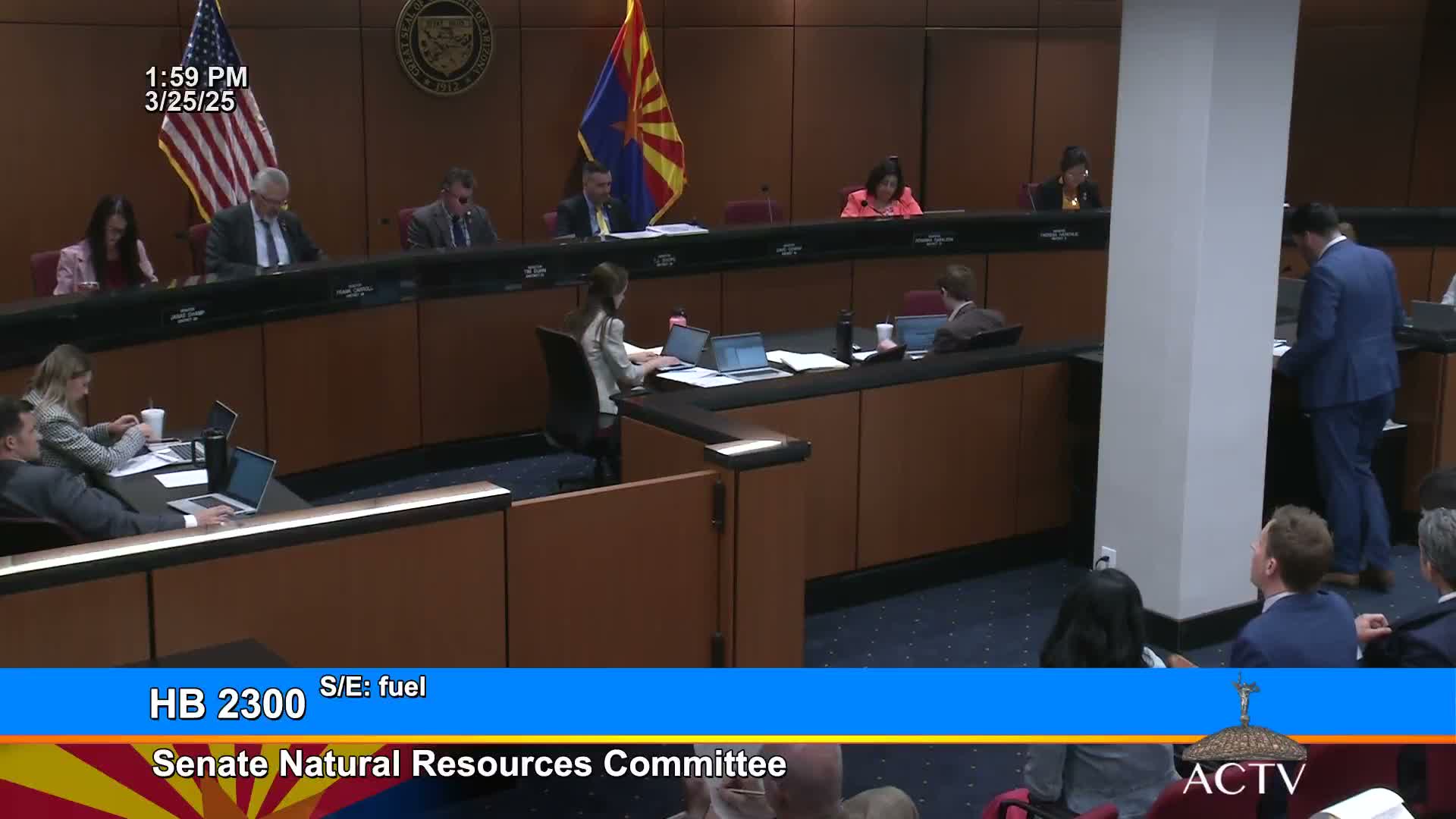
Senate Natural Resources Committee advances bill that broadens gasoline formulation options, draws agency and environmental concern
Summary
The committee heard a strike‑everything amendment to HB 2,300 that would expand area‑by‑area gasoline formulation options and create a short waiver process; ADEQ warned of required SIP modeling and Clean Air Act constraints while environmental and industry witnesses gave opposing views. The committee moved the bill forward as amended.
The Senate Committee on Natural Resources advanced a bill that would expand the number of gasoline formulations approved by area in Arizona and establish a short‑term waiver process for supplies that cannot meet the statutorily prescribed formulations.
The committee opened debate on a strike‑everything amendment to House Bill 2,300 (in Senator Schoeps’ name) that—if adopted—would allow additional gasoline fuel reformulation options for counties with more than 1.2 million residents and in designated areas, permit a 20‑day waiver on the grounds of a demonstrated supply shortage, and require the Arizona Department of Agriculture to post maps and an approved‑formulations list online. The amendment conditions state rule changes on EPA approval of a revised State Implementation Plan.
Krista Osterberg, chief legislative liaison for the Arizona Department of Environmental Quality, said ADEQ is neutral but raised two main concerns. “We are neutral on this bill with 2 main points of concern,” Osterberg said, noting the fuels listed would require additional modeling to revise the State Implementation Plan and that the Clean Air Act constrains when waivers can be approved. She told senators a prior effort showed additional SIP modeling could cost in the range of roughly $100,000–$150,000 and that ADEQ expects modeling and EPA approval timelines could be lengthy.
Weights and Measures compliance manager Vince Wolpert described the existing Cleaner Burning Gasoline (CBG) program and the technical constraints the state faces. “Weights and Measures, our sole mission is to ensure integrity in the marketplace, and protect air quality,” Wolpert said, and noted that Arizona has no in‑state refineries and relies on a constrained, out‑of‑state pipeline supply.
Environmental and industry witnesses split on the bill. Sierra Club Grand Canyon chapter director Sandy Barr urged rejection, warning the Clean Air Act “does not allow backsliding” and saying adding formulations without adequate air‑quality study risks weakening public‑health protections. By contrast, Jody Mueller of the Western States Petroleum Association said Arizona’s supply system is complex and argued more formulation options do not automatically improve supply and could create logistical barriers for deliveries.
Representative Biasucci, the bill sponsor, said the amendment completes work begun last year and argued the change would help address disparities in fuel prices between urban and rural areas. After discussion and questions, the committee adopted the strike‑everything amendment and the sponsor moved HB 2,300 as amended for a due‑pass recommendation. The chair announced the bill had been given a due‑pass recommendation as amended.
What happens next: The measure was moved forward out of committee; any changes to the state implementation plan will require EPA approval and ADEQ modeling. The department’s stated modeling timeframe and the Clean Air Act’s waiver standards were central concerns during the hearing.