Get Full Government Meeting Transcripts, Videos, & Alerts Forever!
Get email alerts on the Rv Cooling Units topic
No spam. Unsubscribe anytime.
Senate committee advances bill letting long‑term RV residents install cooling units
Summary
The Senate Regulatory Affairs and Government Efficiency Committee voted to give House Bill 21-68 a do-pass recommendation after adopting an amendment that narrows the prohibition to motor homes, park trailers and travel trailers; sponsor Matt Gress said the measure protects residents during extreme Arizona heat.
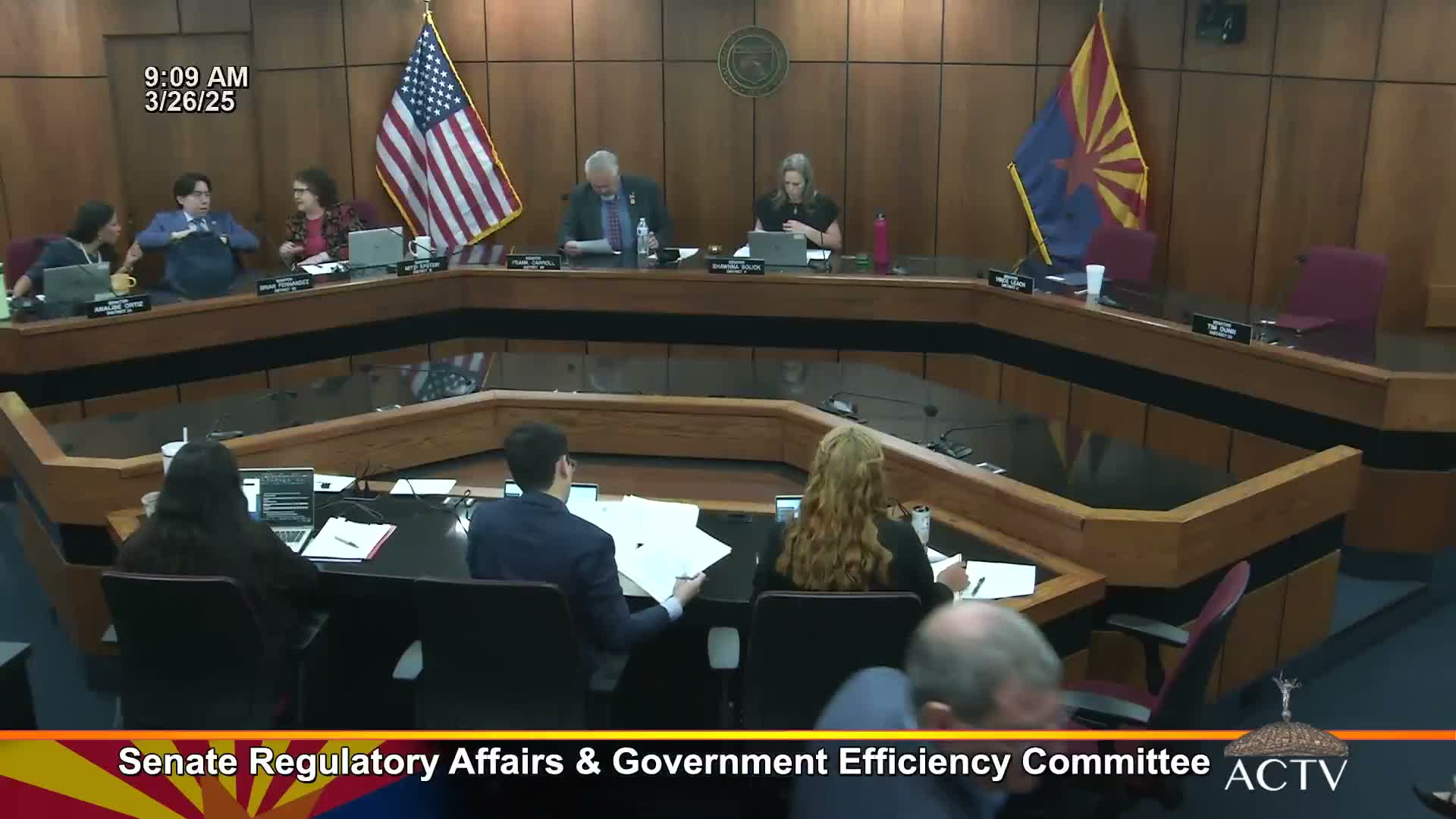
The Senate Regulatory Affairs and Government Efficiency Committee on March 25 gave House Bill 21‑68 a do‑pass recommendation after adopting an amendment that narrows the measure to certain types of recreational vehicles.
Sponsor Matt Gress (Legislative District 4) said the Arizona Mobile Home Owners Association brought the bill after reports that RVs permanently sited in parks were being prevented from installing window air‑conditioning units. "When it's 110 degrees outside I think it's a bit inhumane to say, 'Well this doesn't look pretty, so we're not going to allow it in the mobile home,'" Gress said in committee.
The measure, described by staff as an emergency statute, would prohibit an RV park landlord from preventing a tenant from installing "reasonably necessary commercial cooling methods" on an RV. The four‑page amendment in Senator Leach's name, adopted in committee, confines the prohibition to motor homes, park trailers and travel trailers, excluding pop‑up campers and small truck‑bed campers.
Supporters framed the bill as a public‑safety and equity issue in Arizona's heat. Dana Paschke of the Arizona Association of Manufactured Homeowners testified that long‑term RV residents fall under the Long‑Term RV Act and said the amendment captures units that are effectively permanent residences.
The committee adopted the amendment and approved the bill on a roll call that recorded seven ayes, zero nays. The committee's do‑pass recommendation moves the amended bill forward to the next procedural step.
No public opponent testimony was recorded in the hearing.