Get Full Government Meeting Transcripts, Videos, & Alerts Forever!
Get email alerts on the Payments Crypto topic
No spam. Unsubscribe anytime.
Committee advances bill allowing state agencies to accept cryptocurrency for payments and tax remittances
Summary
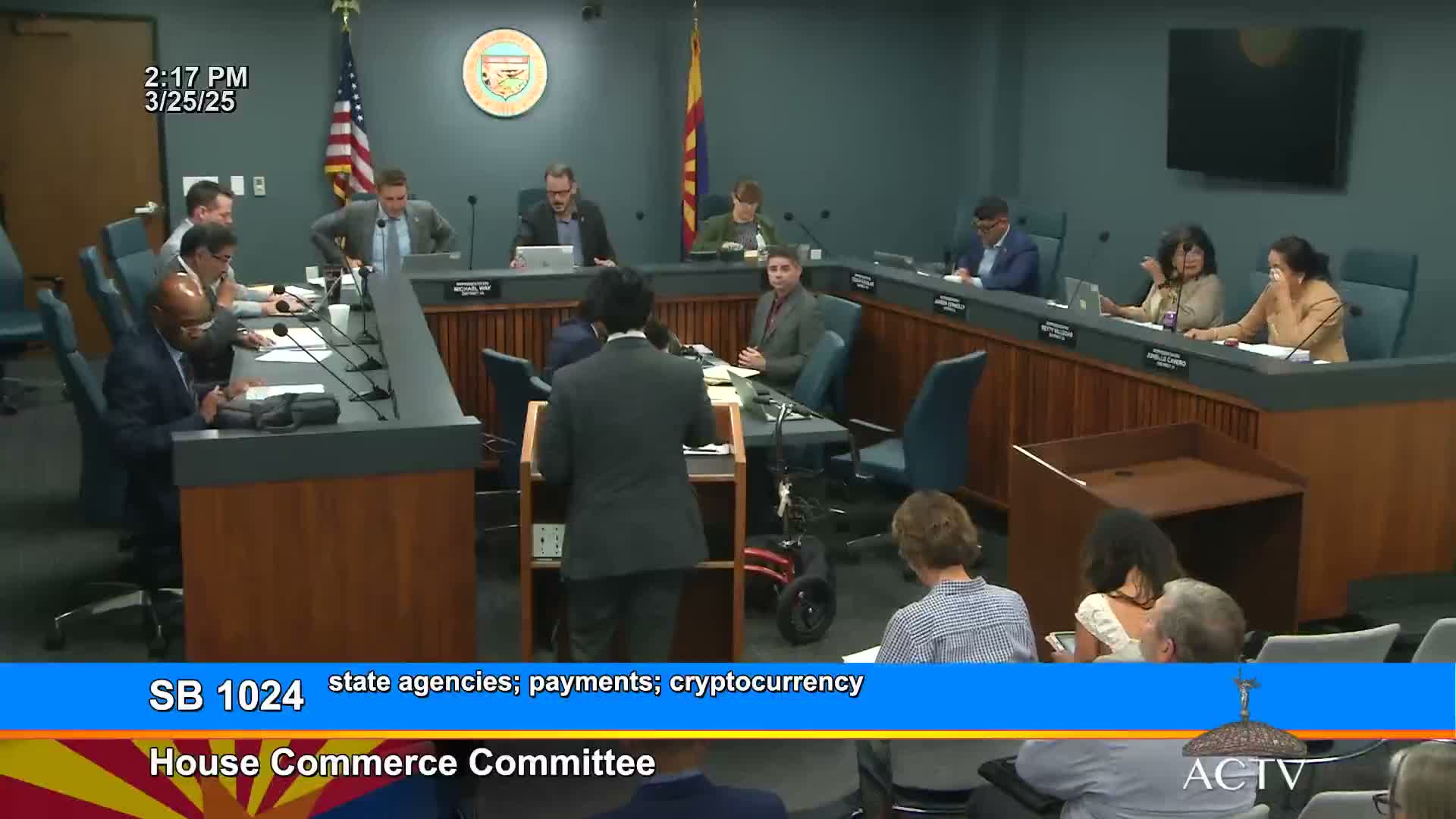
The Arizona House Commerce Committee voted 6–4 to advance SB 10 24, which permits state agencies to contract with cryptocurrency service providers to accept digital currencies for certain payments and tax remittances; sponsors said agency agreements and third-party gateways limit state risk.
Senators and staff told the House Commerce Committee on March 24 that SB 10 24 would let state agencies enter agreements with cryptocurrency service providers to accept cryptocurrencies as payment for certain amounts due to the state, including tax remittances if the Department of Revenue signs an agreement with a provider.
Sponsor Sen. Wendy Rogers framed the bill as a long-running legislative effort to give taxpayers an additional payment option. "This enables you to pay your taxes with crypto," Rogers said, adding that agency contracts and third‑party gateway services mean the State would not be the counterparty to volatile crypto transactions.
Committee members questioned how agencies would choose providers and whether the process required centralized oversight. Representative Burke urged an RFP process or some statewide oversight for third‑party selection, saying fiscal responsibility argues for clear procurement steps. Chair and staff responded that under the bill a state agency "may enter into an agreement" and agencies would generally negotiate their own terms; the chair said he would be open to sponsor amendments to require consultation with the governor's office or Arizona Department of Administration.
After a brief discussion the committee adopted a motion to return SB 10 24 with a due‑pass recommendation. The roll call recorded 6 ayes and 4 nays.
What happens next: The bill will be carried to the House floor with a committee recommendation; sponsors indicated they could consider language clarifying procurement or oversight if members request it.
Votes and formal action: SB 10 24 was moved for a due‑pass recommendation and advanced by a 6–4 committee vote.