Get Full Government Meeting Transcripts, Videos, & Alerts Forever!
Get email alerts on the Groundwater Management topic
No spam. Unsubscribe anytime.
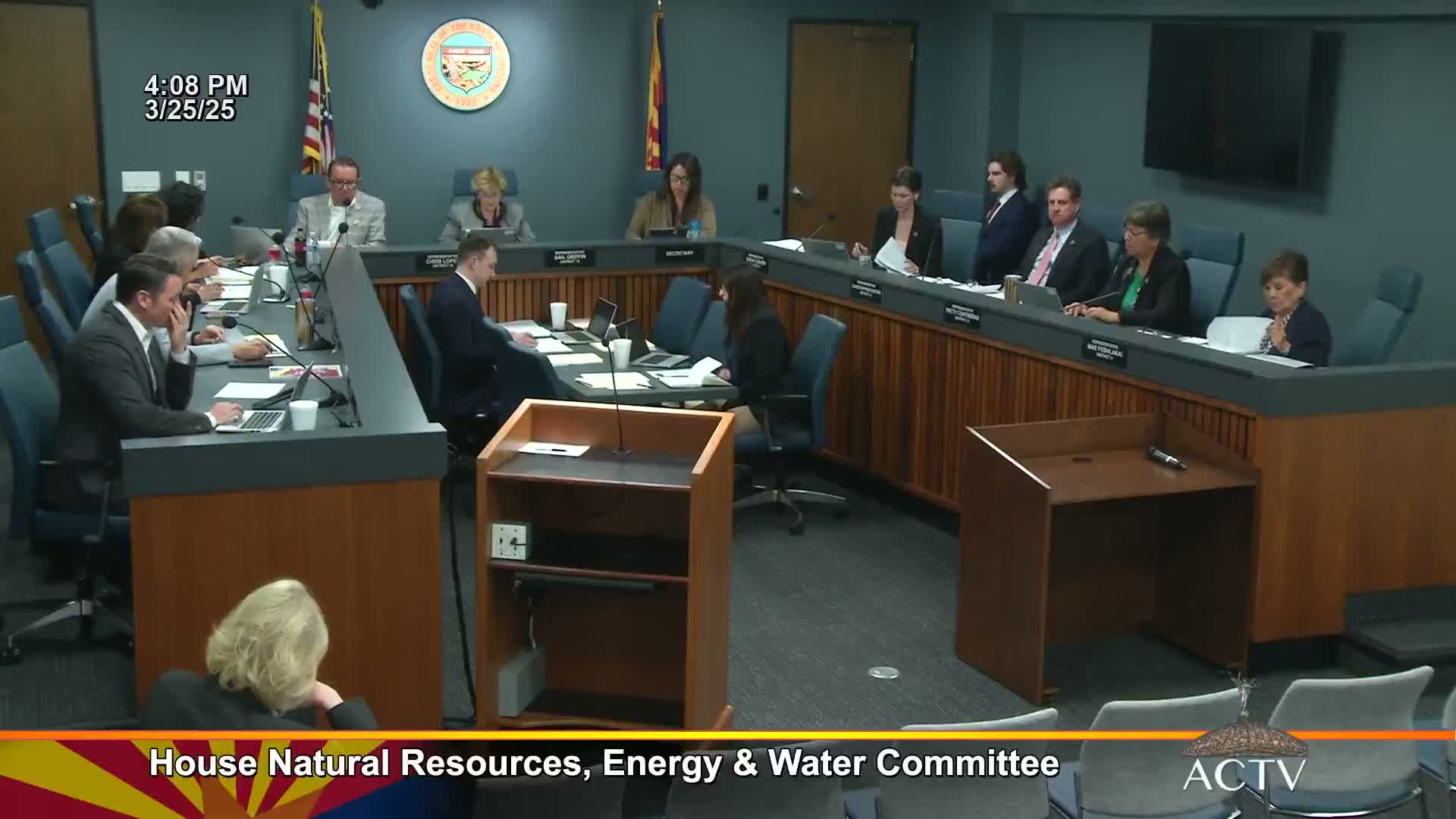
After marathon hearing, committee advances Basin Management Area bill as amended amid fierce local opposition
Summary
The committee passed Senate Bill 15‑20 as amended, creating a new Basin Management Area framework limited initially to Wilcox, Gila Bend and Hualapai basins; the bill drew hours of testimony from residents, farmers, environmental groups and industry disputing caps on mandatory reductions, council composition, and funding.
A lengthy and often emotional committee hearing ended with the Natural Resources, Energy & Water Committee returning Senate Bill 15‑20 with a do‑pass recommendation after adopting an amendment by Chair Griffin.
Sponsor Senator Tim Dunn said the bill aims to provide local tools and a management framework for basins experiencing severe overdraft — targeted to Wilcox, Gila Bend and Hualapai — including basin councils, certificates of groundwater rights, flexibility accounts and a statutory process for designation. Dunn said the measure is meant as a pragmatic, negotiable framework: "We need something to negotiate on," he told the committee.
But the hearing devolved into hours of public testimony, much of it from Wilcox Basin residents and domestic well owners who said the bill, as drafted, would not halt decline. Steve Kisla, a Wilcox resident, told the committee that the basin faces a roughly 350% overdraft and that a statutory cap limiting mandatory reductions to 10% would be insufficient. "Simply put, this bill will leave the Wilcox Basin high and dry," Kisla said.
Environmental groups and public‑interest witnesses echoed that view, warning that the bill would cap reductions at levels too low to stabilize aquifers and that the council composition and flex‑account structure risked commodifying water without appropriate safeguards.
Agriculture and industry witnesses presented a different urgency: they urged policies that provide certainty for existing investment and warned that larger mandatory cuts or poorly designed markets would undermine rural economies. The Arizona Farm Bureau said the measure is a starting point to create local certainty and flexibility for agricultural economies.
After hearing dozens of speakers, the committee adopted an amendment (Griffin, 03/24/25 11:14AM) clarifying director findings for designation and public meeting requirements and adding specified data to the designation process. The committee voted to return the bill with a due‑pass recommendation by a 6‑4 margin. Several members who supported the motion stressed they viewed the committee vote as an invitation to continue intense stakeholder negotiation before floor action.
Why it matters: The legislation attempts to give rural Arizona more local say over groundwater while balancing statewide policy goals. Opponents say the ceiling on mandatory reductions, the composition of basin councils and insufficient funding and enforcement would fail to protect wells and communities. Supporters say the statute sets a workable framework to negotiate stronger protections over time.
Next steps: SB 15‑20 advances to the House floor. Sponsors and stakeholders pledged continued negotiation on council makeup, conservation targets, enforcement, and funding before final passage.