Get Full Government Meeting Transcripts, Videos, & Alerts Forever!
Get email alerts on the Arts Grants Review topic
No spam. Unsubscribe anytime.
Panel urges clearer evidence of impact after reviewing Wisconsin arts grant applications
Summary
After a daylong public review, the Wisconsin Arts Board panel commended many strong artistic proposals but repeatedly called on applicants to provide measurable evaluation, budget reconciliation and clearer accessibility planning before awards are finalized.
The Wisconsin Arts Board convened a public panel to review grant applications from arts organizations across Wisconsin on Dec. 5, 2025. Panelists commended many proposals for artistic quality and community programming, but repeatedly asked applicants to show clearer measures of impact, reconcile budget documents with narrative totals and spell out concrete accessibility measures.
Panel chair Karen opened the livestream and highlighted procedural details for scoring. Early critiques set the tone: a reviewer observed that one Door County application "read a little bit like an invitation as opposed to a grant application," underscoring the panel’s need for measurable goals and evidence of community benefit. Across categories — theater, visual arts, festivals, community arts and museums — reviewers sought three kinds of clarifications: clear evaluation plans with quantitative and qualitative evidence; reconciled budgets that explain irregular items (large gifts, capital campaigns or deferred compensation); and straightforward descriptions of accessibility work (captioning, ASL interpretation, transportation funds and pay-what-you-can models).
Panelists highlighted some examples of good practice: applications that paired specific program goals (for example, attendance targets and demographic goals) with participant quotes or short case studies; applicants who provided a one-page financial reconciliation tying narrative totals to the uploaded 990; and those who clearly described accessibility accommodations tied to specific events. Panelists also called out avoidable presentation issues — blank or poorly formatted uploads, unexplained acronyms, and missing marketing plans — which made review harder for readers unfamiliar with particular regions. Several reviewers reported the online review platform timed out or locked while they were working and asked staff to follow up with the vendor.
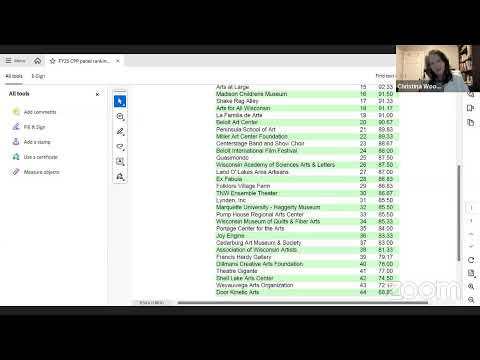
On larger institutions, discussion focused on capital campaigns, endowment usage, and the implications of programs embedded within universities or larger organizations. Staff explained that scores feed into a formula that also accounts for budget category. After tabulating scores, the panel signaled that it was prepared to recommend awards to the applicants it reviewed, while asking staff to provide technical assistance to organizations that need help clarifying materials before final notification.
The panel’s recommendations and applicant notifications will follow in the standard award cycle. Staff said they will follow up with applicants about missing or inconsistent documentation and will work with the review-platform vendor to address intermittent save/timeout problems reported by multiple reviewers.