Get Full Government Meeting Transcripts, Videos, & Alerts Forever!
Get email alerts on the Arts Grants Review topic
No spam. Unsubscribe anytime.
Wisconsin Arts Board panel reviews dozens of grant applications; calls for clearer impact metrics and financial transparency
Summary
The Wisconsin Arts Board convened a livestreamed review of arts grant applications, praising many programs’ artistic strength while urging clearer evidence of community impact, better budget transparency, and improved accessibility. Panelists scored applicants and recommended funding across the pool.
The Wisconsin Arts Board held a public, livestreamed review of grant applications on Dec. 5, 2025, hearing presentations and panel critiques of dozens of arts organizations across the state. Panel members praised strong artist rosters and community programming, but repeatedly asked applicants for clearer evaluation data, more explicit strategic planning, and fuller financial disclosures.
Panel chair Karen and facilitator Bill opened the session by confirming the livestream and recording. The panel then rotated through rounds of first and second readers for each applicant. Early in the meeting, one panelist said of a Door County kinetic-sculpture applicant: "this application read a little bit like an invitation as opposed to a grant application" (panel comment), noting a lack of measurable community outcomes. Panelists asked similar questions across many applications: Who exactly benefits? How will success be measured? Where do surpluses and deficits come from and how are reserves handled?
Panelists repeatedly flagged budget discrepancies and missing supporting documents. For example, reviewers noted several applications whose narrative totals did not match the uploaded 990 or budget worksheet. On multiple occasions, supporters recommended applicants include a one-page financial summary that reconciles budget lines and explains irregular items such as large one-time gifts or capital campaign income.
Accessibility and audience reach were recurring themes. Reviewers commended efforts such as ASL interpretation, pay-what-you-can admission, and outreach to rural communities, while asking organizations to clarify what they mean by terms like "barrier free" and to provide concrete steps (for instance captioning, transportation funds, or accessible program design) that lower participation barriers.
The panel also discussed process and presentation problems that made review harder: several applicants uploaded blank or poorly formatted marketing plans and some used many unexplained local acronyms, making it difficult for readers unfamiliar with a specific region to assess proposed partnerships and impact. Panelists recommended applicants write plainly and include brief context for partners and programs.
On evaluation, several organizations were singled out for good practice: those that tied specific program goals to measurable outcomes, included participant quotes or short case studies, and showed how evaluation had changed programming. Reviewers asked others to follow those examples: combine quantitative indicators (attendance, demographics) with one or two illustrative participant stories.
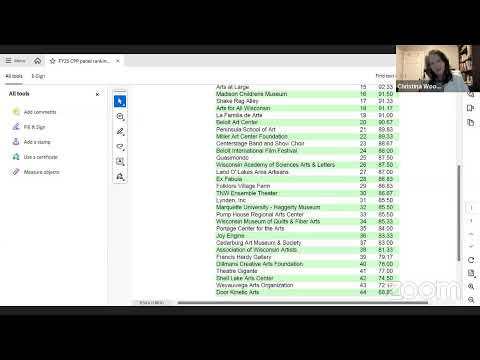
Panelists also spent time reviewing large-budget institutions together, focusing on capital campaigns, endowment use and the mechanics of affiliation (for example, when a museum program is embedded within a university or a larger institution). Staff advised that scoring feeds into a formula that also accounts for budget category; the panel ultimately agreed the set of applicants reviewed were generally ready for awards this cycle and recommended funding across the list.
The session closed with a process debrief. Several panelists reported intermittent issues with the online review system timing out while they worked; staff said they will follow up with the platform provider. Panelists asked staff to share these findings with applicants so organizations can strengthen future submissions by: spelling out acronyms and partners, reconciling budgets to uploaded financials, documenting measurable impact and evaluation, and clarifying accessibility measures.
The board paused the meeting to tabulate scores and confirmed the panel’s recommendation to fund the reviewed applicants. Staff will notify applicants of final awards and work with any organizations needing technical assistance to improve application materials for future rounds.