Get Full Government Meeting Transcripts, Videos, & Alerts Forever!
Get email alerts on the Housing Infrastructure topic
No spam. Unsubscribe anytime.
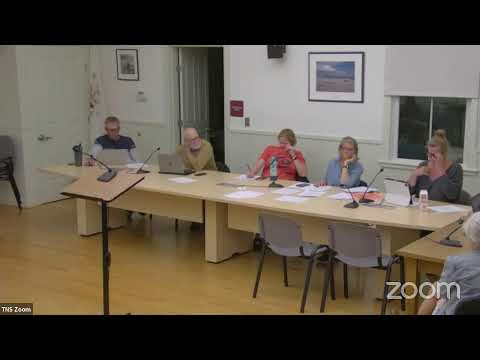
Block Island housing board approves utility 'trunk line' concept and retools Ball O’Brien project after state funding denials
Summary
The Block Island Housing Board agreed to move forward, in concept, with installing a utility trunk line onto the Ball O’Brien (Westside) property while it reconsiders project design and funding sources after two rejections from Rhode Island Housing; the board will confirm grant scope and water/sewer connections before contracting.
Speaker 1 (presiding officer) said the board is revisiting the Ball O’Brien/Westside housing project after two rejections from Rhode island housing and described a plan to “stub” utilities roughly 20 feet into the site so the project can advance without locking in a final design.
The board heard that it has a $300,000 award from the Rhode Island Infrastructure Bank and an additional grant from the Rosa Foundation, and Speaker 1 read a contractor estimate for limited utility work that he summarized as roughly "$301,000.855." He told members the earlier full project estimate had totaled about $6.5 million and that earlier infrastructure-only estimates exceeded $1 million when foundations were included.
Why it matters: board members said state funding programs carried eligibility rules and income caps that made the proposal unworkable in its prior form. Speaker 1 said Rhode Island Housing rejected the project twice for being too small in scale and too costly per square foot, and the board agreed not to rely solely on that funding source this cycle.
What the board decided: after technical and financial discussion, members voted their approval, aloud, to proceed in concept to install a trunk line and to engage the contractor to prepare revised estimates—contingent on two conditions the board specified: (1) confirming with the town water and sewer authority that connections and laterals are feasible and (2) ensuring the infrastructure work requested falls within the $300,000 grant scope. Speaker 1 said the board would “remove the drainage” (rain garden) from the immediate contract if reengineering made that prudent.
Funding and design trade-offs: members discussed alternatives to make the project financially viable, including fewer, larger buildings to lower per-unit costs, a mixed program of for-sale and rental units to offset capital expenses, borrowing scenarios (examples discussed using $6 million or $4 million as placeholders), and seeking private partners or developers who can leverage tax credits or guarantees. Several members noted many mainland developers prefer larger portfolios and that the town’s small project size complicates purely developer-driven financing.
Next steps: the board assigned follow-up tasks—ask the contractor (Bain/Bane) to produce a revised estimate focused on a trunk line; Keisha was asked to prepare extension paperwork for the $300,000 Rhode Island Infrastructure Bank grant; Speaker 1 said he will verify the grant’s covered scope with their grant point person (Lisonbee) and check DigSafe/road-cut permitting. The board also agreed to prepare pro forma scenarios to model hybrid financing (partial borrowing plus private fundraising) and to take a written pitch to potential development partners.
Votes and formal actions: earlier in the meeting the board approved the Sept. 17 minutes and later recorded an affirmative voice vote to authorize, in concept and contingent upon the conditions above, engaging the contractor for trunk-line installation. The minutes and the trunk-line authorization were recorded by voice vote with members responding "aye." The meeting closed with assignments to tighten financial numbers and outreach materials.
The board plans to reconvene after the contractor provides updated estimates and after staff confirms water, sewer and grant-scope questions.