Get Full Government Meeting Transcripts, Videos, & Alerts Forever!
Get email alerts on the Committee Priorities topic
No spam. Unsubscribe anytime.
Coastal Resilience Committee maps 2025 priorities, urges advocacy for full-time resilience officer
Summary
The Block Island Coastal Resilience Committee set priority actions for 2025 during a Nov. 6 meeting, endorsing data collection, ordinance review and community engagement and adding advocacy for a full-time resilience officer and study of peer towns to its objectives.
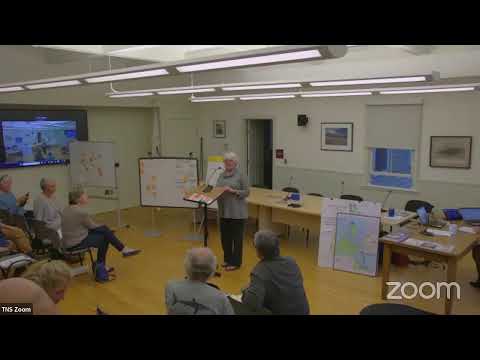
The Coastal Resilience Committee met Nov. 6 in New Shoreham to finalize its priorities for 2025 and to consider how to reorganize working groups around those goals. The committee approved its September minutes and then ran a sticker-vote exercise to rank actions under three mandate areas: data and threat assessment, community engagement, and adaptation/mitigation recommendations.
The Committee Chair (not named in the transcript) led the session and told members she plans to step away from the chairmanship to focus on family caregiving but will remain on the committee and continue technical work such as the Corn Neck Road study. “I want to step away from the chairmanship of this committee,” the chair said during the meeting.
Members used six green “priority” stickers and optional red “remove” stickers to indicate top actions. Facilitators summarized the tallies: objective 1 (collecting and synthesizing coastal resilience information and translating sea-level-rise data into local action) and objective 2 (engagement with the Coastal Resources Management Council and improving property-owner access to mitigation information, plus an annual summer engagement forum) received strong support. Objective 3’s top items included reviewing town ordinances and coordinating community feedback on the Corn Neck Road grant.
A substantive point of debate concerned whether the committee should identify or recommend limits on development in known-risk areas. Some members placed red stickers on a line item that proposed limiting development, saying that formal land-use restrictions are the responsibility of planning and zoning boards and the conservation commission. Others argued the committee should keep such items visible so it can advise town staff and elected officials.
A near-consensus emerged around advocating for a full-time resiliency officer. One member urged the committee to “advocate for a full time position” to provide continuity and manage the many partnerships and grant requirements that the volunteer committee cannot staff. Facilitators then ran a quick straw poll and added the resilience-officer proposal and a study of what other towns have done to the committee’s active objectives.
The discussion also turned to working groups. Members debated whether to retain existing working-group labels, reorganize them by objective or by vulnerable-area projects (for example, Corn Neck Road, Ocean Avenue North, Bridgegate Square), and which groups should take on data-collection and synthesis tasks. Several members noted that much of the technical data and modeling reside at universities and state agencies and that the committee’s role is to translate that work into locally actionable guidance and public-facing information.
The chair closed the session after encouraging members to volunteer for working groups or points-of-contact and to reconvene with a proposed structure. The committee will distribute the sticker tallies and follow up on assigning people to the prioritized objectives.