Get Full Government Meeting Transcripts, Videos, & Alerts Forever!
Get email alerts on the Municipal Priorities topic
No spam. Unsubscribe anytime.
New Shoreham council lays out priorities: tax reform, deer management, parking and community facilities
Summary
In a wide-ranging work session the New Shoreham Town Council discussed property-tax reform and homestead-exemption follow-up, multi-year deer-management funding and regulation, parking and shuttle options, community center ideas, school building use and digital permitting challenges; staff will present policy drafts and department-head updates in coming weeks.
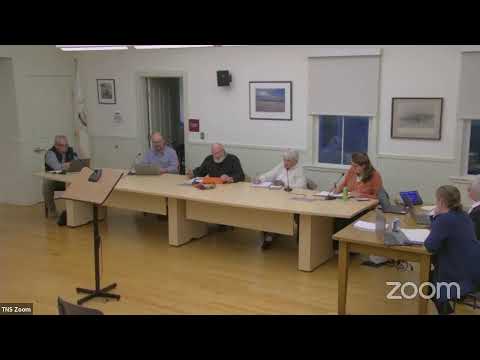
The New Shoreham Town Council used its work session to brainstorm a set of priorities the body wants staff to advance over the coming months, with discussion touching on property-tax reform, deer management, parking policy, the future use of the local school and public-safety buildings, and investments in electronic permitting systems.
Speaker 6 opened the conversation by urging the council to continue work on a "more refined property tax system that better reflects consumption and town services," noting the town’s earlier passage of a homestead exemption and saying the next step could include extending benefits to year-round rental providers. Speaker 3 said extending homestead-style relief to non-owner, year-round landlords will require new legislation and specific language.
Council members also flagged that existing ordinances — for example, outdoor entertainment and noise rules — have not kept pace with local needs and recommended a future work session with staff and stakeholders to identify statutory or ordinance gaps.
Deer management emerged as a sustained priority. Speaker 6 framed the issue as both a public-health problem (tick-borne illness) and an ecological problem (loss of plant species), and several members said the town needs a multiyear program instead of one-off seasonal efforts. Staff estimates discussed: Speaker 4 put the deer fund this year at between $20,000 and $30,000, and the council observed that at current reimbursement rates that funding covers only a portion of annual removals. Speaker 10 offered a financial framing: "by spending $30,000 a year... you have a present value of $436,000" over 30 years at 5.5% — a calculation speakers used to weigh recurring expenditures versus a capital approach.
On parking, the council discussed demand-management tools such as electronic paid parking and targeted shuttles to move visitors from downtown to the town beach on peak days. Staff reported coordination with the Department of Environmental Management (DEM) on a proposed small number of reserved placards for medical and special-purpose parking; Speaker 4 said DEM has provisionally proposed 22 spaces and that a full draft policy will come before the council.
Speakers also discussed community facilities: a community-center concept was raised and members recommended a citizens’ committee to research options and bring proposals to the council. The future of the local school building was discussed as a possible community anchor; Speaker 6 urged that any renovation contemplate multiuse community functions. Council members asked that school-committee meetings be more visible; staff confirmed the committee will hold a meeting at town hall on Dec. 16 and will try to hold future meetings there so the public can watch.
Staff and council discussed digital services and permitting: the town has implemented OpenGov for permits and licenses, but staff warned backend finance tracking and training remain a heavy lift and that the town needs time to 'digest' recent deployments before adding more systems.
Procedurally, the council scheduled a department-head session and training (including open-meetings/APRA refresher) to occur in mid-December; staff will present policy drafts and follow-up items in subsequent meetings. No formal votes on these priority items were taken at the work session.
The council adjourned after confirming dates for upcoming meetings and assigning staff follow-ups.