Get Full Government Meeting Transcripts, Videos, & Alerts Forever!
Get email alerts on the Dark Sky Ordinance topic
No spam. Unsubscribe anytime.
Foster council continues dark‑sky lighting ordinance after questions on enforcement and 'shall' language
Summary
Council and residents pressed staff to clarify whether the proposed dark‑sky ordinance would be mandatory or advisory for residential fixtures and who would enforce it; after extended public comment the council continued the hearing to a joint meeting with the planning board.
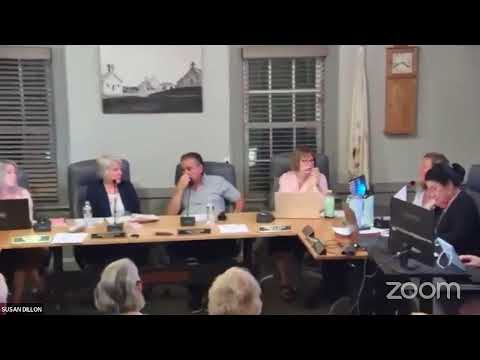
An extended discussion at the Foster Town Council meeting on the proposed dark‑sky exterior‑lighting ordinance ended with the council continuing the second hearing to allow staff and the planning board to clarify ambiguous language and enforcement responsibilities.
The presenter read the ordinance purpose, saying, "The general purpose of this article is to protect and promote the public health, safety, and welfare, the quality of life, and the ability to view the night sky by establishing regulations and a process of review for exterior lighting." The draft requires lighting plans for new developments and directs review to either the planning board (for land development) or the building official (for fixtures added to existing uses), but many provisions use words such as "encouraged" and "may," not absolute mandates.
Residents at the meeting pressed the council to remove conflicting mandatory phrasing. Nicole Andruscavage (Foster Center Road) told the council the ordinance mixes advisory guidance with mandatory terms, saying, "'Shall' to me is mandatory," and urged substitution with softer language such as "should" or similar alternatives so that ordinary residential changes do not trigger unanticipated enforcement.
Council members and residents also asked how compliance would be measured. The presenter noted the draft contains objective criteria for illumination levels and fixture types and read the enforcement passage, which allows the town to notify property owners, require remedial action and, if corrective action is not taken within 30 days, "the town may initiate appropriate legal action." Council members proposed replacing general references to "town" with the specific office that will act — the building official — and flagged the need to reconcile when planning‑board review, building‑official sign‑off or simple electrical‑permit review apply.
After audience discussion and a request to bring technical experts to a joint meeting, a council member moved to continue the hearing on chapter 18 (nuisances, including sections on purpose, criteria, administration and enforcement) so staff can revise ambiguous language and the planning board can participate; the motion was seconded and approved by voice vote.
The council said the continued hearing will appear on a future agenda with updated language and anticipated guidance from the planning board and the town's building and zoning official.