Get Full Government Meeting Transcripts, Videos, & Alerts Forever!
Get email alerts on the Police Station Grant topic
No spam. Unsubscribe anytime.
Glocester council debates next steps after referendum, warns of lost grants tied to police station project
Summary
Council members said they sought extra time to avoid losing a $5,000,000 state grant for a proposed police station; officials also warned that a $165,000 dispatch earmark and a $400,000 tower replacement could be at risk because the projects are linked.
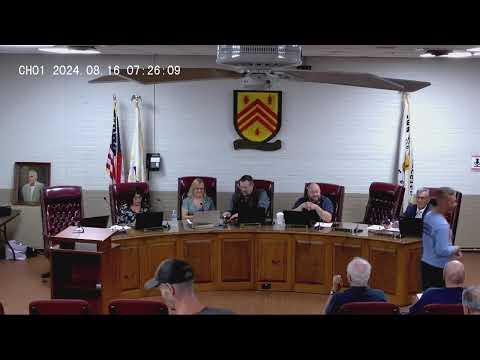
Glocester — At its Aug. 15 meeting, the Glocester Town Council discussed efforts to avoid forfeiting a $5,000,000 state grant tied to a proposed police station project and warned that related federal and earmarked funds could be jeopardized by the recent referendum result.
Council members said they did not intend to overturn the public vote but wanted more time to determine whether the town could still meet grant matching requirements without undermining the referendum. “We don't wanna lose $5,000,000,” the council president said in open forum, describing efforts to negotiate schedules and cost reductions so the town might preserve the state award.
Town officials told the council the original project plans predated the current council and that need assessments and planning work began in February 2019. They said some grant awards were contingent on related elements of the project: an earmark of roughly $165,000 for dispatch and emergency-operations capacity and a separate tower-replacement cost estimated at about $400,000. Staff warned those items were in a project pipeline and could be withdrawn if the overall project no longer proceeded as planned.
The council described a back-and-forth with the state and federal offices involved: staff said the office of U.S. Sen. Jack Reed had contacted the town to ask whether Glocester remained in the project pipeline and that the town may learn the status of some earmarks in September. The chief and grants staff noted that keeping earmarks had been a multi-year effort and that losing them would shift costs back to local capital accounts.
The discussion followed public remarks from residents expressing concern about existing building problems — including water intrusion and mold in the current station — and from officials who said the project's scope and cost had grown from early estimates. Council members emphasized they had aimed to "buy time" to explore options, not to reverse the vote. The council confirmed it would bring refined cost and funding figures back to the public and to a future meeting for further consideration.
What happens next: Council said staff will return with detailed numbers and clarifications about which grant elements can be retained, and the town expected to learn more from federal and state contacts in the coming weeks. No new financing decision was made at the Aug. 15 meeting.