Get Full Government Meeting Transcripts, Videos, & Alerts Forever!
Get email alerts on the Workforce Housing Application topic
No spam. Unsubscribe anytime.
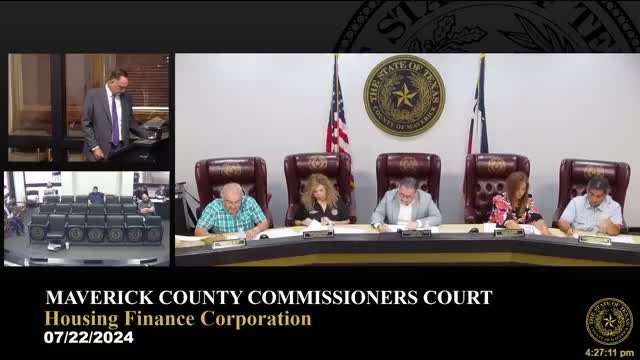
Maverick County HFC adopts a standard application for workforce housing; board reads resolutions and moves into executive session
Summary
The board approved a standard application form for multifamily workforce housing and heard counsel outline how tax-exempt financing and fees work; the board read resolution language authorizing developer agreements and then moved into executive session to review related real-estate matters.
The Maverick County Housing Finance Corporation reviewed and approved a standard application form for multifamily workforce housing and discussed how the HFC will structure developer fees and tax-exempt financing.
Counsel described the purpose of the application: developers seeking HFC financing or a property-tax exemption will submit a completed application that specifies required covenants, issuer fees and other terms. Bond counsel said the form promotes consistency across deals to avoid ad-hoc negotiations.
Counsel and staff explained differences between housing authorities and an HFC: "The housing authority operates under chapter 392 of the local government code. Housing finance corporation is under chapter 394," an advisor explained, noting that each entity may serve different populations and that an HFC can operate inside or outside the county depending on the project.
Key financial examples discussed (presented by staff and counsel) included a formation/MOU/formation fee example of $20,000 for joint-venture/ground-lease/new-construction processing; participation in sales-and-use tax savings where a general-contractor role could earn 25% of the savings; a structuring/issuer fee example of $300,000 on certain financings; an initial regulatory compliance fee illustrated at $100 per unit for the first year; and an annual lease payment equal to 10% of ad valorem tax savings. Counsel also noted issuer fees for bond deals often run about 1% of the bond aggregate and that lease-revenue bonds are paid from project rents, not from a county tax levy.
What the board decided: Commissioner Ramos moved to approve the standard application for workforce and affordable multifamily projects; Commissioner Rios seconded the motion and the directors approved the application by unanimous assent. The board then proceeded with prepared language for Resolution HFC 24-0001 authorizing the HFC to enter necessary agreements with developers to acquire, develop or rehabilitate workforce housing projects in Texas. The transcript records the board moving into executive session at 4:59 p.m. to review legal and real-estate questions; the meeting record indicates the board intended to take up related Resolution HFC 24-0002 in that executive session.
Context and constraints: Counsel emphasized the developer (or a single-purpose entity set up for the project) would be responsible for bond repayment and project risk; the HFC’s role is to serve as issuer and to set covenants that secure lower rents for qualified tenants in exchange for property-tax exemptions that apply in the jurisdiction where a project is located.
Ending: After approving the application and reading the resolution language, the board moved into executive session for legal review of real-estate matters.