Get email alerts on the Planning Code Enforcement topic
No spam. Unsubscribe anytime.
Commissioners press planning department on trash and code enforcement; require monthly reports
Summary
Commissioners said trash and code-enforcement issues persist in Precinct 4, directed planning staff to identify ordinances and bring codified enforcement options back to court, and voted to require monthly written reports from the planning department to the commissioners' court.
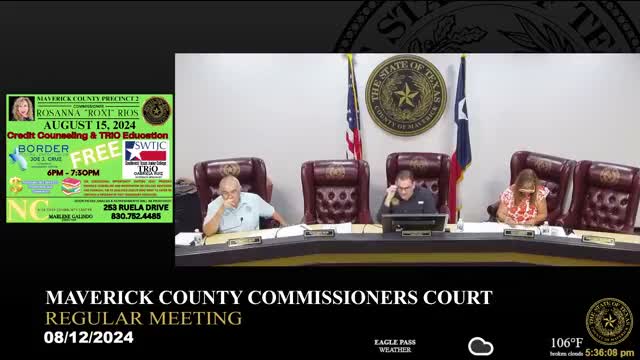
Commissioner Reese pressed planning staff at the Aug. 12 Maverick County Commissioners Court meeting about persistent trash, illegal dumping and code-enforcement effectiveness in Precinct 4, saying residents continue to report problems and that visible trash remains a frequent complaint.
Planning Department staff told the court they have been issuing more than 100 letters per week and are working through a backlog left by a prior director. The department said it has been researching other counties’ approaches, coordinating with the landfill and other partners, and reviewing which ordinances can be enforced at the county level. A county legal advisor recommended the planning department locate any previously adopted county ordinances (some dating to the 1970s) and, if necessary, present new draft ordinances for court approval so the county can ‘‘put some teeth’’ into enforcement.
Commissioners asked how the county can impose fines and what procedural steps are required for abatement orders and lien assessments. Staff explained that abatement orders go to the court and, once approved, can result in lien assessments and billing for cleanup; actual issuance of fines may require coordination with law enforcement (sheriff or constable) depending on the county’s statutory authority.
After discussion the court directed the planning department to meet with Commissioners Reese and Ramos, coordinate with Road & Bridge and legal counsel, and return with recommended ordinances or an enforcement plan. The court set a follow-up meeting for Wednesday at 10 a.m. and voted unanimously to require the planning department to submit written monthly activity reports to the commissioners’ court, beginning with the next month’s regular meeting. The monthly-report requirement was presented as a step to improve transparency and give commissioners a regular factual record of enforcement actions, notice letters issued, abatement activity and any outstanding needs for staffing or funding.
Commissioners specified they expect the reports to include counts (letters issued, abatement orders, sites cleaned), a summary of outstanding problems by precinct and any recommended ordinance language or administrative changes necessary to improve compliance. Planning staff said they would compile the information and return with draft language or options for the court to consider.
The court’s direction stops short of immediate new fines or penalties; instead, staff were asked to identify existing legal authority and to bring proposed changes back to the court for formal adoption if needed.
AI generated
The text on this page is AI generated. Summaries, highlights, analysis, and video transcripts are all produced from the original source material.
AI can make mistakes, so if you spot one, and we will fix it for everyone.
Note: the source content is unaltered by us. Any content source we link to, be it a video, an audio recording, or a document, is presented exactly as its publisher released it. That publisher is usually a government body, sometimes an individual official or another organisation.