Get Full Government Meeting Transcripts, Videos, & Alerts Forever!
Get email alerts on the Community Development Cdbg topic
No spam. Unsubscribe anytime.
Maverick County court advances local resolution to seek 2025–26 Texas CDBG funding
Summary
At its Dec. 9 meeting, the Maverick County Commissioners Court considered and moved to adopt a local resolution committing the county to apply for 2025–2026 Texas Community Development Block Grant funds; county staff outlined priority project types and cited differing maximum-award figures in the discussion.
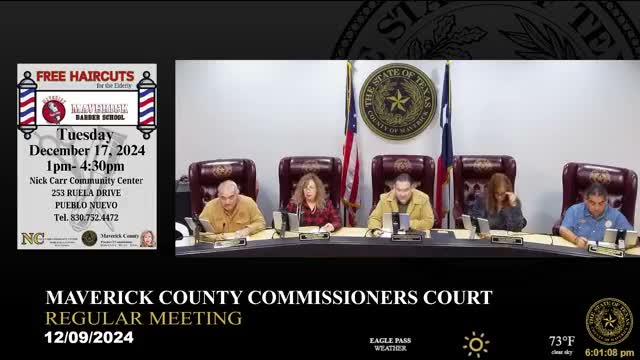
The Maverick County Commissioners Court on Dec. 9 took up a local resolution to commit the county to submit a 2025–2026 Texas Community Development Block Grant (CDBG) application, with a motion made by Commissioner Reese and seconded by Commissioner Rios.
County staff told the court the resolution and related paperwork from MRGDC had been submitted and must be filed before 11:59 p.m. "That's right," staff acknowledged when asked about the deadline. The judge said the county will provide a 0% local match for this grant; county staff confirmed that statement during the discussion.
Why it matters: Texas CDBG funding is aimed at local community development projects such as streets, water and wastewater improvements, and other infrastructure. County staff said wastewater and basic infrastructure projects typically score highest in the application process, and that the county would identify specific projects and priorities after the preliminary application step if selected.
County staff described project-selection procedure: the current item was framed as a preliminary application; if Maverick County is selected in January the county would then identify site-specific projects. "We'll sit down and look at it," staff said, describing a tiered prioritization (tier 1, tier 2, tier 3) that would steer funds toward the most viable community projects.
Speakers also gave several figures for potential award sizes and cost caps that were not consistent across the discussion. On different occasions staff and another speaker referenced numbers including "$75,050,000," "$7,750,000," and "$750,000," and separately cited an engineering cap of about $85,000 and administrative-fee allowances. The transcript shows these figures were spoken aloud during the meeting; the court did not document a single definitive maximum-award figure in the recorded discussion. County staff said the maximums discussed are broad and that actual charge amounts may be lower: "If they charge max, it doesn't mean that they will charge the max," staff said.
A motion to adopt the resolution was made and seconded; the presiding official encouraged commissioners to contact grants and planning staff to identify precinct-specific needs. The transcript records the court calling for the question and then proceeding to the next item; a formal tally for the resolution beyond the call for favor is not recorded in the transcript provided.
What’s next: County staff said that if the county is selected in January, the planning office and grants staff will work to identify eligible projects and follow the state's guidance for tiered priorities. The resolution and preliminary application process, as discussed, is an initial step toward applying for CDBG funds.
Sources: Text of the court's meeting transcript, Dec. 9, 2024.