Get Full Government Meeting Transcripts, Videos, & Alerts Forever!
Get email alerts on the Operation Lone Star Audit topic
No spam. Unsubscribe anytime.
Maverick County accepts state Operation Lone Star audit, votes to convene workshop after local auditor dispute
Summary
County officials accepted a Texas governor—s office audit of an Operation Lone Star grant and directed a multi-party workshop after the county attorney said local auditors declined to seek reimbursement on roughly $300,000 in courtroom equipment and flagged $202,554 in salary reimbursements.
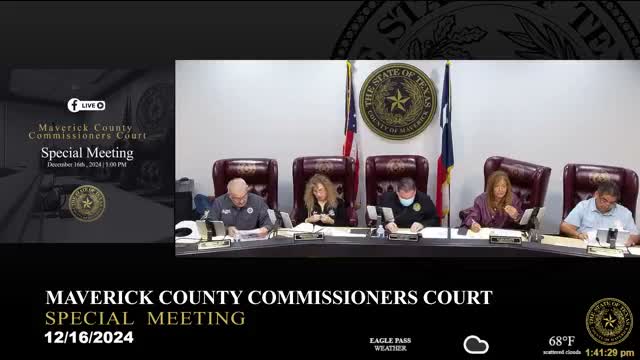
The Maverick County Commissioners Court on Dec. 16 accepted a state audit of the county's Operation Lone Star (OLS) grant and agreed to convene a workshop with district judges and the auditor's office to resolve outstanding reimbursement and reporting disputes.
County Attorney (project director) reviewed an audit from the governor's Office of Compliance and Monitoring covering grant period ending in '03 and said auditors found issues totaling roughly $35,000 out of a $4,000,000 grant but also identified two larger local problems. He told the court that local auditors declined to seek reimbursement for more than $300,000 in courtroom equipment the county had purchased and installed and later refused to turn in salary documentation for $202,554 in personnel costs, which jeopardized reimbursement.
"Out of $4,000,000, they needed clarifications and some amendments that we needed to do," the county attorney said, adding that the governor's office had confirmed many of the county's positions and that the $300,000 reimbursement "had every opportunity to be refunded to Maverick County." He said the governor's office told the county the local auditors acted independently in their decision not to pursue the reimbursements.
Cynthia Diaz, a member of the public who spoke during the meeting, separately urged the court to consider personnel actions related to allegations against the county attorney, noting a nonsuit had been filed in recent court proceedings but that the allegations retained public salience.
Commissioners raised concerns about communication between offices and the timing of invoices. Several said the local auditing office is in an interim status and that hiring or training decisions and clearer processes are needed to avoid future lost reimbursements. One commissioner proposed, and the court approved, setting a date for a workshop to include district judges, the auditor's office and grant administrators to "get on the same page." The court approved the motion to accept the state audit unanimously.
The county attorney described steps already taken to address audit findings, including clerical corrections, creation of standard contracts for recurring vendors (interpreters and stenographers), line-item clarifications and updated personnel and contract policies for grant compliance. He said the county will continue to pursue reimbursement and has requested extensions or clarifications from the governor's office where possible.
What happens next: the court directed staff to schedule a workshop in January with the relevant parties to review audit findings, submission deadlines and training needs; several commissioners indicated they will pursue additional legal remedies if necessary. The court postponed no formal reversal of the local auditor's decisions during the public meeting; some disputed items were flagged for follow-up and possible further action in executive session.