Get Full Government Meeting Transcripts, Videos, & Alerts Forever!
Get email alerts on the Agriculture Plant Board topic
No spam. Unsubscribe anytime.
Senate agriculture committee advances bill to broaden plant board nominations, citing Supreme Court ruling
Summary
The Senate Agriculture, Forestry & Economic Development Committee voted to pass Senate Bill 191, a revisit of a measure from two years ago that would reform the state plant board and broaden the governor's nominee pool; sponsor Sen. Dave Wallace said the bill "conforms with the recent Supreme Court ruling."
The Senate Agriculture, Forestry & Economic Development Committee voted to advance Senate Bill 191 after a short presentation and a voice vote.
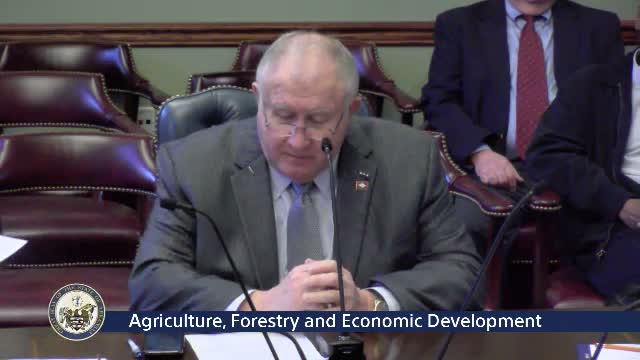
Senator Dave Wallace of District 19, the bill's sponsor, told the committee SB 191 is "a repeat of the bill we did 2 years ago" and described it as reforming the state plant board and its nomination process to conform with "the recent Supreme Court ruling." Wallace said the change would allow the governor to choose from a wider pool of people with interests in seed growing and selling, farming, cattle, and timber. He also told the committee, "There's no known opposition."
During a brief exchange, Senator Leddy said he supported the bill "just for my own education" and asked about language on page 2 describing a "practical corn, peanuts, sorghum ... or wheat grower," questioning the use of the adjective "practical." Wallace replied that the wording is older statutory language and said, jokingly, that an "impractical" grower "doesn't last long in the business."
A motion "do pass" on SB 191 was made and seconded; the committee approved the motion by voice vote with no opposition announced on the record. The transcript does not identify who moved or seconded the motion.
After the vote, Wallace recommended the committee review other boards modeled on the plant board because there "may be future land or lawsuits" affecting those entities. The committee then adjourned and took a head count for a tour scheduled the next day of medical marijuana growing facilities and an optional dinner.
The committee did not record any formal written opposition during the meeting, and no amendments or budgetary changes were discussed. Next procedural steps (e.g., committee reporting to the full Senate) were not specified on the record.