Get Full Government Meeting Transcripts, Videos, & Alerts Forever!
Get email alerts on the Oil Well Assessment topic
No spam. Unsubscribe anytime.
Senate committee advances bill to standardize valuation of oil-production property amid assessor objections
Summary
The committee voted to advance House Bill 1755 to change how oil wells and production equipment are valued—defining production equipment, setting a $1-per-foot casing valuation, redefining 'newly discovered' production and removing a three-year moving average—while county assessors warned the measure could undermine market-value requirements.
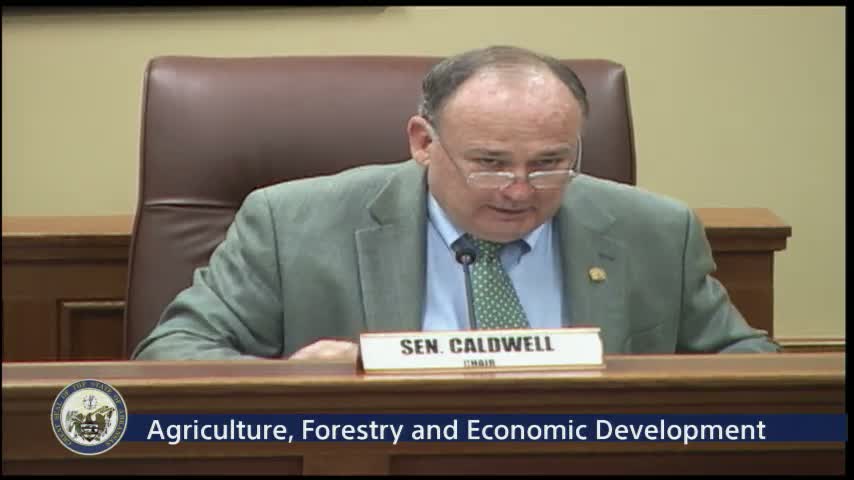
The Senate Agriculture, Forestry & Economic Development Committee voted to pass House Bill 1755, a measure that seeks to standardize how oil wells and related production equipment are assessed for property-tax purposes.
Sponsor Senator Trent Garner told the committee the bill resolves uncertainty for oil producers by defining production equipment ("from the bottom of the casing to the sale value of the tank battery"), applying a $1-per-foot valuation for casing and related equipment, defining when property qualifies as "newly discovered," removing a three-year moving average from the calculation and setting a uniform per-barrel expense allowance in working-interest valuations. "This is a fair and equitable system that will put them in line and make sure they know moving forward what they owe," Garner said.
Supporters from the oil industry and commission testified the changes provide transparency. James Langley, a 50-year producer, said reworking wells commonly restores production and the bill clarifies that only production from a newly tapped zone or a newly drilled well should be treated as "newly discovered." Rodney Baker, executive director for Arkansas Independent Producers and Royalty Owners, and Jim Phillips, a sitting oil and gas commissioner, described county variation in assessment practice and said commission records provide the data needed for the bill's formula.
Opponents, represented by Washington County Assessor Russell Hill speaking for the Arkansas Assessors Association, warned the bill could conflict with statutory duties to value property at market value. Hill cited a statute as read in the hearing (quoted in the record as "code 26 26 19 o 2") and argued the bill would push valuation toward "use value" for a distinct group and remove valuation discretion from county assessors, creating equity concerns across taxpayers.
Witnesses debated technical points: industry witnesses said comparable sales are scarce for producing oil properties and assessors use future-income formulas; Hill said set dollar amounts in law could become outdated and noted historic agency minimum assessments that have been applied inconsistently (witnesses discussed a $300 minimum and a commonly applied $3,250 figure). Jim Phillips said the measure relies on commission records and established formulas and would reduce guesswork.
After closing remarks from Sen. Garner, the committee moved to pass HB 1755 by voice vote. The transcript records multiple proponent and opponent statements and technical exchanges; the committee's recommendation advances the bill to the next stage of consideration.