Get Full Government Meeting Transcripts, Videos, & Alerts Forever!
Get email alerts on the State Meat Inspection topic
No spam. Unsubscribe anytime.
Senate committee pauses state meat-inspection plan after funding and lab-capacity questions
Summary
Lawmakers heard arguments that a state meat inspection program would boost local processors, keep processing dollars in Arkansas and help food banks, but they pulled HB 1315 after extensive questions about who will pay startup costs, lab capacity and long-term sustainability.
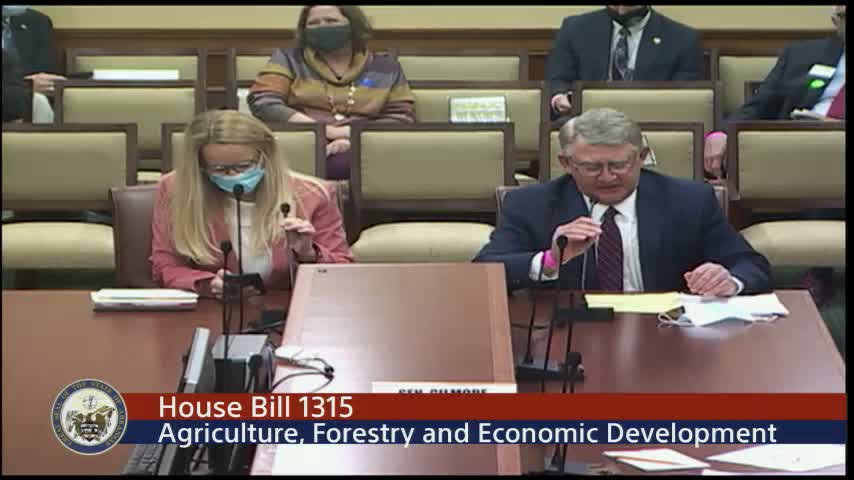
Senators on the Agriculture, Forestry & Economic Development committee heard detailed testimony on House Bill 1315 — a rewrite of the state Meat Inspection Act designed to create a state meat inspection program — but delayed action after members pressed for clearer budget and laboratory-cost information.
The bill’s sponsor described the measure as modernizing state inspection to mirror USDA standards, shifting oversight from the Department of Health to the Arkansas Department of Agriculture and allowing inspected products to be sold at farmers markets, restaurants and schools. Proponents argued the change would keep processing dollars in-state and grow rural processing capacity.
"This is consumer driven," the sponsor said, urging that consumers want to know where meat comes from and how it was processed. Proponents cited a study that estimated Arkansas loses about $405 million in processing-related revenue and said CARES Act grants already directed $10.4 million to upgrade 33 in-state processing facilities.
Jessica Clauser Burcomb, speaking for the Arkansas Farm Bureau, told the committee there is a USDA 50% cost-share program for state inspection startup and that $750,000 in initial funds could be used to get the program started and secure reimbursements. "You get it started," she said, "and the Arkansas Department of Agriculture will submit this state program for approval at USDA and will receive up to 50% reimbursement from the federal government." (Jessica Clauser Burcomb, Arkansas Farm Bureau.)
Committee members repeatedly asked who would pay ongoing inspection costs and whether the department would be empowered — and compelled — to recover its costs by setting inspection fees. Senator Sample pressed whether fee authority was permissive or mandatory; witnesses pointed to statutory language on page 15 that allows the Department to collect fees and elsewhere states the secretary "shall" set an inspection fee sufficient to recover costs.
Wes Ward of the Arkansas Department of Agriculture told senators the department lacks staff to implement a program immediately and has asked for $750,000 in additional general revenue over two years to hire an initial GS-10/11 position, undertake rulemaking, prepare USDA plans and begin inspections. Ward said laboratory testing could be contracted with neighboring states during the startup phase to avoid immediate lab build-out.
"We actually have a have a conversation with USDA FSIS this afternoon," Ward said, adding the governor submitted a letter to joint budget for personnel and a line item to start the program. He recommended treating the effort as a two-year pilot to establish rules and a plan for USDA approval before full statewide rollout.
Michelle Shope, director of food sourcing and logistics at the Arkansas Hunger Relief Alliance, testified the bill would benefit food banks and cited a 2018 Feeding America estimate that 17.3% of Arkansans face food insecurity. Shope described the Arkansas Beef Project, which purchases and processes cattle into ground beef for distribution, and urged sustaining momentum from CARES Act investments.
After extended questioning on lab costs, fee language and whether new inspectors would create a long-term general revenue obligation, the committee agreed to "pull the bill down" so the department can return with specific startup figures, lab-cost estimates and a clearer sustainability plan. No formal vote on HB1315 was taken; the bill will return when the requested information has been provided.