Get Full Government Meeting Transcripts, Videos, & Alerts Forever!
Get email alerts on the Feral Hogs topic
No spam. Unsubscribe anytime.
Arkansas expands USDA-backed feral hog pilot, hires first statewide coordinator
Summary
State Agriculture Secretary Wes Ward and JP, the department’s new feral hog coordinator, told the joint House–Senate Agriculture Committee the USDA NRCS/APHIS pilot funds aided hiring 10 local technicians, supported removal and surveys across tiered counties, and could expand with supplemental NRCS funding pending a 25% non‑federal match.
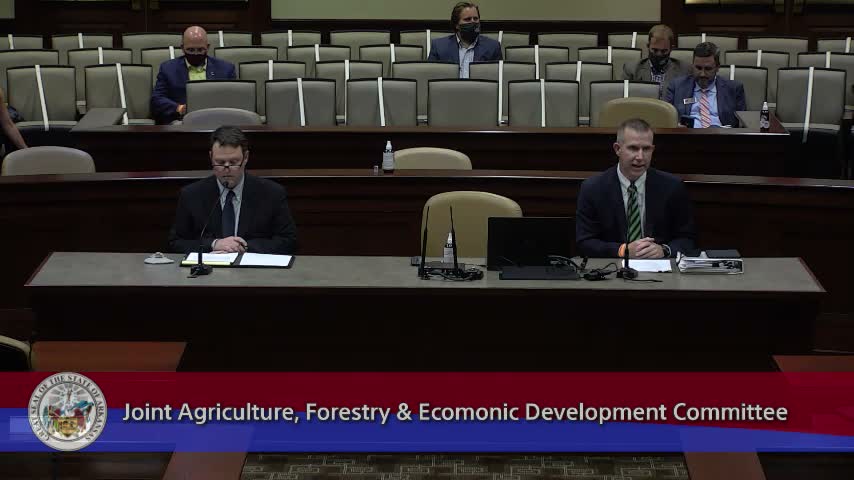
State Agriculture Secretary Wes Ward and JP Fairhead, the department’s newly appointed feral hog coordinator, updated the joint House and Senate Agriculture Committee on a USDA‑funded pilot program to remove and assess feral hog populations across Arkansas.
Ward recounted the task force’s formation after 2016 concerns and said a 2018 Farm Bill pilot grant awarded roughly $3,400,000 enabled expanded eradication efforts and legal clarifications. JP described how the pilot is implemented jointly by USDA’s APHIS Wildlife Services and NRCS, with three coordinated components: APHIS removal operations, NRCS‑supported habitat restoration, and producer assistance through partner agreements.
JP said the state combined planned project areas for streamlined distribution and hired 10 conservation‑district technicians (the first started in July; the last two began the Monday of the meeting). Those technicians are training with APHIS, assisting on trapping and removal on private land, and will help secure landowner permissions and complete pre‑ and post‑removal surveys carried out by the University of Arkansas Division of Agriculture.
The pilot is organized into tier 1 and tier 2 counties across four combined project regions (Arkansas River Valley, North Central, Southeast and Southwest Arkansas). JP said the pilot projects can run one to three years and receive up to $1.5 million in NRCS funding per project with a 25% non‑federal match requirement.
On potential round‑2 supplemental funding, JP confirmed the department submitted a proposal (about $3.6 million requested) and expected NRCS to respond within roughly 30–45 days of the July 31 submission. He cautioned the 25% match (about $1.5 million on that request) may require in‑kind and cash commitments from partners and conservation districts; Farm Bureau has offered in‑kind equipment and other partners may contribute.
Committee members pressed for measurable outcomes. JP said success is hard to define beyond counts of hogs removed and changes in catch effort per unit; the survey and damage‑assessment work are intended to provide before/after documentation. Members also raised enforcement and operational concerns around aerial gunning permits and landowner permissions; Ward and JP said the department is streamlining the permitting process and clarifying guidance for landowners and contractors.
The department plans continued coordination with the task force, local conservation districts and partner agencies as the pilot concludes at the end of the 2018 Farm Bill period (projected Sept. 30, 2023, for the current scope).