Get Full Government Meeting Transcripts, Videos, & Alerts Forever!
Get email alerts on the Recreation Trails Atv Tourism topic
No spam. Unsubscribe anytime.
Arkansas Senate Committee Opens Study on Expanding ATV Trails; Agencies, Riders and Neighbors Weigh In
Summary
A Senate interim study on expanding ATV/UTV tourism drew testimony from state agencies, industry groups and residents, with proponents touting rural economic gains and opponents warning of safety, erosion and policing problems; agencies flagged funding options and complex land‑management limits.
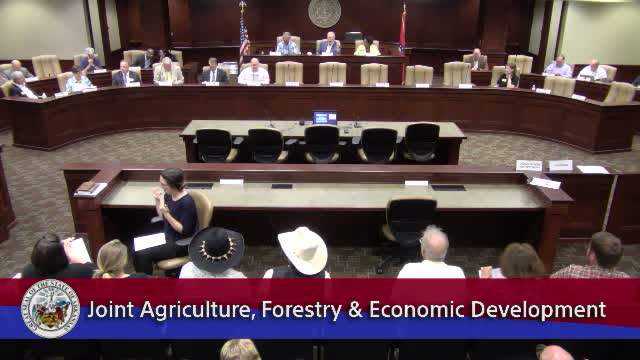
The Senate Agriculture, Forestry & Economic Development Committee convened to begin an interim study on expanding all-terrain-vehicle (ATV) and off-highway-vehicle tourism in Arkansas, hearing agency briefings, industry pitches and numerous public comments that alternated between economic promise and local-safety worries.
Representative Tom Capp, who sponsored the enabling bill during the recent regular session, told the committee the study’s goal is “to increase all terrain vehicle tourism and economic development in the state and promote the economic well-being of small businesses catering to all terrain vehicle tourism.” Capp said the panel should bring Forest Service, state parks and local officials together to identify practical, coordinated steps.
Local riders and business owners described tourism benefits. Chris Muldoon, an insurance agent and cabin-rental operator from Johnson County, said roughly 40 percent of his rentals are for people who come to ride, many from out of state, and estimated his county has about 86 miles of Forest Service-approved trail segments that are not yet linked into continuous loops. “We would like to see continuous loops to, you know, take your family out and enjoy a half day of riding or a full day of riding,” Muldoon said.
Industry representatives pressed the committee for code consolidation and a dedicated funding stream. Robert Blake, president of the nonprofit Off Highway Visions, distributed materials drawn from other states and urged Arkansas to modernize its laws and local permissions. He cited a federal industry figure — "a hundred and $120,000,000,000 overall for the industry" — as a rationale for making Arkansas more welcoming to OHV visitors, while acknowledging state law will need updating to reflect modern vehicles.
State agencies described limits and resources. David Bell, chief of policy and legislative affairs at the Department of Parks, Heritage and Tourism, said the department can provide tourism promotion and conservation perspectives but noted that federal, state and private lands operate under different rules and that the study should include significant data collection on economic impact and land‑use constraints. Joe Jacobs of Arkansas State Parks reported two parks with established ATV trails: Mount Magazine (a short state-park trail that connects to roughly 40 miles of Forest Service trails) and Daisy State Park (about 2.5 miles inside the park that extends to roughly 20 miles on U.S. Army Corps land). Jacobs emphasized that those state-park routes often sit on leased federal land and therefore follow federal land managers’ rules.
The Arkansas Department of Transportation urged caution about public-road connections. Laurie Tudor, ARDOT chief operating officer, noted legal definitions in current code that affect which roads could be considered for trail connections, recommended excluding fully controlled-access or interstate-type facilities, and said safety is the department’s primary concern. Tudor also reported that about $410,000 in federal Highway Administration funds is available annually for motorized-trail development, subject to a nonfederal 20 percent match (which can include donated materials or services).
Public comment split sharply. Donnie Stewart, who operates a private off-road park in Boxley Valley, said private facilities can draw older and family visitors and urged liability relief for private owners who charge fees. “We need to be included in that liability relief,” Stewart said, noting volunteer and training models used in other states to handle trail maintenance.
By contrast, several residents near existing trail systems described repeated damage, noise, and unsafe riding. Royal Wade Kimes, who lives on Kimes Mountain, reported deep ruts, off‑road drivers entering private property and multiple incidents he said threatened lives and local infrastructure. “This is a disaster,” Kimes said, arguing that expanded access would change the character of mountain communities and increase safety and erosion problems.
Committee members asked agencies to assemble more data and policy options for the interim study: maps of existing motorized and nonmotorized routes, crash and traffic-volume data, cost estimates for trail development and maintenance, and legal analyses of liability and land‑use authorities. David Bell said his department will gather available studies and tourism‑impact information for committee review.
Next steps: the committee opened a public‑comment period at the meeting and will use the interim study to collect additional stakeholder input and agency analyses before making legislative recommendations. No substantive change to state law or formal trail designations occurred at the session; the only formal committee action recorded was approval of the meeting minutes.