Get Full Government Meeting Transcripts, Videos, & Alerts Forever!
Get email alerts on the Water Irrigation topic
No spam. Unsubscribe anytime.
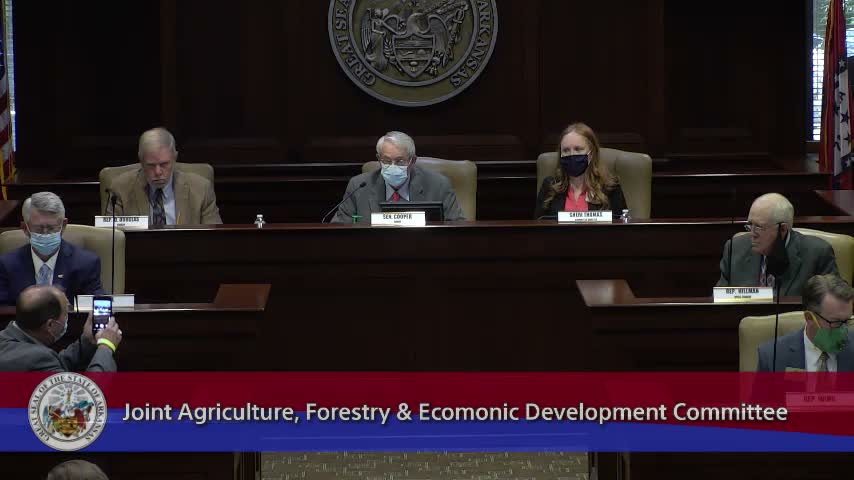
Irrigation project leaders ask legislature to enable tax credits, defend $42-per-acre assessment to finish Grand Prairie delivery
Summary
Officials for the Bayameda/Grand Prairie irrigation projects told the Senate agriculture committee the region—aces groundwater depletion and presented a financing plan that relies on federal grants, a state tax credit and a court-authorized assessment that they say would average about $42 per irrigated acre in phase 1.
Edward Swain, executive director of the Bayameda Water Management Project, told the Senate Agriculture committee that groundwater depletion across the Grand Prairie region threatens the long‑term viability of irrigated row‑crop agriculture and that surface water from the Arkansas River can stabilize supplies.
"When we divided it by the number of acres in phase 1, it comes to $42 an acre," Swain said, describing the project—inancing that combines federal grants, loans and a proposed assessment tied to court authority establishing the district. He said the full estimated cost to farmers would be about $48 for the first acre‑foot when combined with an $18 operation charge and that the financing assumes a state tax‑credit component to reduce the assessment impact.
Swain described completed work — an inlet channel, near‑complete pumping plant and a 40‑acre regulating reservoir — and said additional construction across bridges, canals and on‑farm pipelines is required before the project can deliver water to roughly 90,000 cropland acres in the first phase. He said the district has secured roughly $115 million in federal funds to date and seeks additional NRCS and Corps support, along with a tax‑credit mechanism the legislature can authorize.
Lawmakers pressed project staff on fairness and impacts. Representative Jett said he supports preserving irrigated agriculture but "has a problem with the $42 per acre," asking whether the assessment would be assessed uniformly regardless of actual water use and whether renters or dry‑land owners would be compelled to pay. Swain and other project representatives said the assessment is calculated against cropland as recorded by assessors for phase 1 and is intended to provide a revenue floor so lenders will finance long‑term bonds without shifting repayment risk to the state.
Other legislators raised distributional concerns for young or lease‑based farmers who might face tighter margins. Swain said the financing plan includes a $6.5 million value‑engineering contingency and built‑in inflation and contingency allowances; he urged members to consider tax‑credit options that could be refundable to mitigate effects on low‑liquidity landowners.
The presentation also included a separate update by Dan Hooks of the White River Irrigation District, who summarized completed on‑farm reservoirs, large‑diameter pipes and a near‑complete pump station and asked the committee for continued state support to secure required local matches and loans.
The committee did not take a formal vote on the assessment or tax‑credit request at the hearing. Next steps noted by presenters included finalizing designs, continuing outreach to landowners and seeking state authorization for the tax‑credit element that district leaders say is essential to lower the assessment burden.