Get Full Government Meeting Transcripts, Videos, & Alerts Forever!
Get email alerts on the Plant Board Membership topic
No spam. Unsubscribe anytime.
Senate committee deadlocks on Plant Board cleanup after heated debate over fertilizer and feed representation
Summary
A statutory 'cleanup' to Plant Board appointments prompted extended testimony from industry groups and the Agriculture Department over whether removing or substituting seats would dilute farmer or cotton-industry representation; the committee adopted an amendment but a final 'do pass as amended' motion failed on a voice vote.
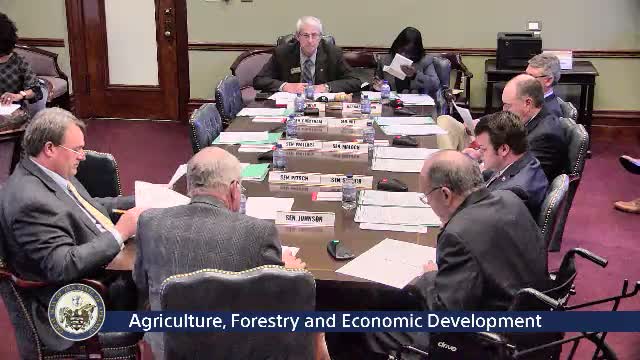
Senators on the Agriculture, Forestry & Economic Development Committee debated amendments to a statutory cleanup bill for the Arkansas Plant Board for more than an hour, culminating in a failed final motion to advance the bill.
Senator Ronald Caldwell, sponsor of the amendment to House Bill 18-54, told the committee the change replaces obsolete language and restores representation for farmers by creating an appointee from the fertilizer industry and substituting the Arkansas Oil Marketers Association for an outdated feed-association appointment. "This would take and put an appointee from the fertilizer industry back on the board," Caldwell said, arguing farmers buy fertilizer in every county and the revision would improve representation.
Marvin Childers, president of the Poultry Federation, told the committee that the Feed Manufacturers Committee historically recommended nominees to the Plant Board and urged the panel to preserve a feed-manufacturing representative even if the Poultry Federation itself does not seek the seat. "We simply believe that somebody in the feed manufacturing industry to be appointed by the governor should stay or remain as a representative of the plant board," Childers said.
Andrew Grubmire of the Agricultural Council of Arkansas said his group supported the underlying cleanup but had "deep concerns" about the amendment because it excludes cotton oil mills and risks diluting farmer voices. He suggested broader interim study and warned about making substantive changes so late in the session. "This is controversial and not something to be considered lightly," Grubmire said.
Wes Ward of the Arkansas Agriculture Department described recent lawsuits and statutory mismatches that motivated the original cleanup bill, and said the department's preference for the session was to correct statutory language to reflect current membership. Ward cautioned, however, that the Plant Board already has many seats and that expanding representation can create practical difficulties.
Supporters of the amendment, including Matt King of the Arkansas Farm Bureau, urged the committee to pass the revised language as a pragmatic step that could be followed by broader, more inclusive legislation later: "Our policy does support having a position on the plant board," King said, while acknowledging concerns about board size.
The committee first voted to adopt the amendment. After extended discussion about whether the amendment or the original cleanup better solved the statutory-membership mismatch and possible legal exposure, members moved for a 'do pass as amended' recommendation. By voice vote the chair recorded more 'no' responses than 'aye' and announced that the bill failed to advance out of committee.
The committee left several open questions, including how quickly appointments would align with statutory language (members serving fixed terms would remain in office until their terms end) and whether an interim study or new seats might be proposed next session to avoid excluding any regulated industries. The bill's sponsor said the measure was intended to align statute with practice and asked members for a favorable vote before the motion failed.
The committee adjourned with no further business.