Get Full Government Meeting Transcripts, Videos, & Alerts Forever!
Get email alerts on the Redistricting topic
No spam. Unsubscribe anytime.
Lawmakers debate competing congressional maps as residents urge keeping counties whole
Summary
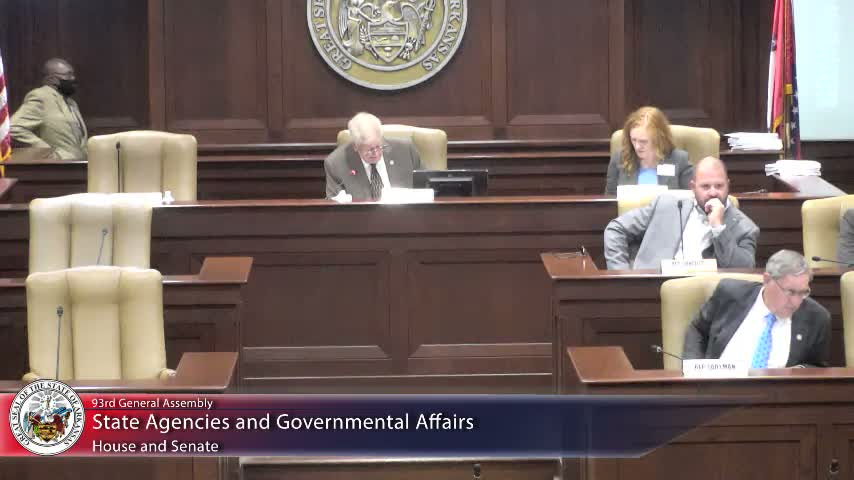
Arkansas legislators reviewed several competing congressional maps and alternatives at a State Agencies & Govt'l Affairs Senate meeting, with sponsors arguing population balance and critics and local officials urging preservation of county lines and community ties.
Little Rock — State lawmakers heard hours of testimony Tuesday on competing congressional redistricting proposals as sponsors defended population-tight maps and local officials and residents warned that splitting counties would fracture representation.
The committee considered multiple bills and alternative maps presented by members of both chambers. Representative Jim Dotson and Senator Brianne Davis described a pair of coordinated proposals that, they said, reduce the number of split counties from five to three and achieve extremely small population deviations — in one version “within 24 people” statewide — while attempting to keep cities and precincts whole. Representative Dotson said maps were drawn to keep districts compact and contiguous and to follow natural boundaries where possible.
Supporters framed their plans as technical efforts to respond to population growth in Northwest Arkansas and losses elsewhere. “We worked very hard to get population as close as we could to keep cities together and keep the lines where they currently are,” Dotson said during his closing remarks.
Opponents said the numerical goals come at the expense of county integrity. Rochelle Britton of Jacksonville testified repeatedly that the student-drawn and sponsor maps would split Pulaski County, Jacksonville and many other counties, calling one version “indefensible” and saying it split as many as 11–12 counties. Sebastian County Judge David Hudson and the Fort Smith Regional Council urged keeping Fort Smith and Sebastian County whole and noted long-standing regional partnerships that could be weakened if the county were moved into a different congressional district.
“There’s a lot of commonality that we have now that we’ll continue to have,” Hudson told the committee, arguing his county’s cohesion with Northwest Arkansas has benefited local lobbying and representation.
Other presenters offered alternate approaches. Representative Ray proposed a map he said preserved more continuity with current districts and reduced the number of splits while keeping deviations under 1 percent. Representative Flowers offered a separate map aimed explicitly at meeting four federal criteria — equal population, contiguity, preservation of political subdivisions and minority representation — and said one district would have about a 51% minority population to address long‑standing underrepresentation.
That proposal prompted a vigorous policy debate on whether drawing a district to enhance minority opportunity risks legal or constitutional challenge. Some members cautioned that race‑centric line-drawing can be constitutionally fraught, while proponents said minority representation is an explicit part of federal guidelines and the Voting Rights Act. “I am not saying this map was drawn to create a minority district,” Flowers said, adding that she considered the four statutory guidelines and that the proposal could reduce litigation risk by addressing minority representation.
Committee members repeatedly returned to tradeoffs: keeping counties intact tends to increase population deviations, while strictly minimizing deviation often requires dividing counties and precincts. Sponsors said they tried many configurations and offered multiple map versions—some that split Saline County, others that instead split Pulaski County—so members could weigh principles against numeric targets.
Public comment came from a mix of local officials, business leaders and residents from across the state. The Fort Smith Regional Council submitted a written endorsement urging Fort Smith remain in the Third Congressional District; several county judges and mayors provided letters and live testimony urging continuity for their local constituencies.
No votes were recorded in the committee session; sponsors said they would continue to refine proposals and invited fellow lawmakers to collaborate on adjustments. The committee moved on after several hours to address unrelated agenda items.
What’s next: The committee did not take final action. Sponsors said they would continue to circulate alternative maps and work with members; additional hearings and markups are expected before any map reaches a floor vote.