Get Full Government Meeting Transcripts, Videos, & Alerts Forever!
Get email alerts on the Voter Id topic
No spam. Unsubscribe anytime.
Senate committee advances bill to require photo ID for absentee ballots, removing sworn‑statement alternative
Summary
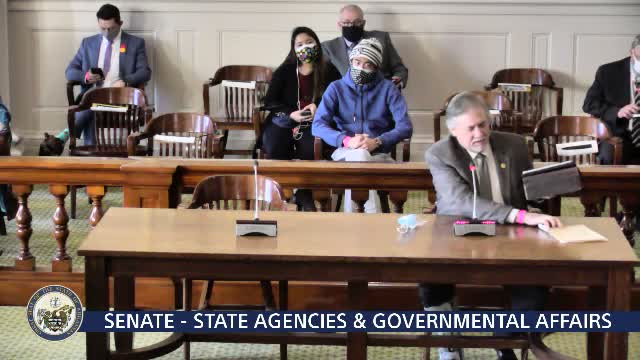
The Senate State Agencies & Governmental Affairs Committee on a party-line mood heard hours of testimony and passed House Bill 11‑12, which would remove the sworn‑statement substitute for a photo ID on absentee ballots; supporters said it restores voter intent and a uniform standard, opponents said it will disenfranchise elderly, disabled and minority voters.
Representative Lowery presented House Bill 11‑12 to the Senate State Agencies & Governmental Affairs Committee, saying the bill removes the sworn‑statement alternative to the photo identification requirement for absentee ballots and restores what he described as the intent of Arkansas voters in 2018.
The measure matters because it changes how absentee votes are verified: under current practice, voters without a photo ID can submit a sworn statement to have their provisional or absentee ballot accepted; HB 11‑12 would require a copy of a photo ID instead. Representative Lowery said the 2018 constitutional amendment and earlier statute showed voters preferred a photo‑ID standard and argued signature verification is not uniform across counties.
Opponents, including Indivisible of Little Rock, the League of Women Voters of Arkansas and the NAACP, told the committee HB 11‑12 would disproportionately burden older Arkansans, people with disabilities and immigrant communities who may lack or have difficulty obtaining or reproducing photo IDs. "This bill would disproportionately disenfranchise older people and those with disabilities," Laurie Evans of Indivisible said. Kathleen Beatty, also with Indivisible, said county clerks she contacted view the change as an undue burden in practice.
Senator Tucker, speaking against the change, cited a FOIA-based county tally presented to the committee reporting 2,699 ballots in 64 counties in 2020 that were counted using the sworn‑statement process; he argued HB 11‑12 would remove a valid pathway that helped those voters have their ballots counted. "Of all 2,699, there were no allegations of a fraudulent vote among any of them," Tucker said during debate.
Proponents argued the change would make verification uniform. Representative Lowery said signature comparison is inconsistent: "Signature verification is not a uniform standard," he said, and cited Pulaski County examples where provisional ballots took weeks to resolve. Supporters noted a 2018 voter approval rate of 79.5% in favor of a photo‑ID amendment and said counties can issue free voter ID cards.
The committee allowed a sequence of public commenters to speak for five minutes each. Speakers against the bill included Miriam Dominguez of Arkansas United (who highlighted immigrant communities), Nell Matthews of the League of Women Voters, TJ Simba Medell (who gave a personal account of family voting), Diane Curry and Natalie James of the NAACP, and others who urged lawmakers to consider implementation burdens such as lack of printers, transportation barriers and equipment problems at county offices.
After closing remarks from Representative Lowery and brief debate, Senator English moved for a "do pass" recommendation and Senator Garner seconded. The committee voted orally (ayes and noes recorded) and passed HB 11‑12 out of committee; the measure will next proceed in the legislative process.
The committee adjourned after the vote. The record shows both procedural debate and substantive public concern; committee members and sponsors said they intend oversight and county support mechanisms, but opponents said the elimination of the sworn‑statement accommodation will create real obstacles for some voters.