Get Full Government Meeting Transcripts, Videos, & Alerts Forever!
Get email alerts on the Medical Marijuana Licenses topic
No spam. Unsubscribe anytime.
Cultivators and patients press lawmakers to push Medical Marijuana Commission to release two reserve licenses; committee recommendation fails
Summary
Reserve-list applicants, patients and some legislators urged the Medical Marijuana Commission to grant two remaining cultivation licenses before a July deadline, citing rapid patient growth, high prices and a court finding of apparent bias in the commission’s process; state agency witnesses disputed a broad supply shortage. The committee’s recommendation to the commission failed on a roll call.
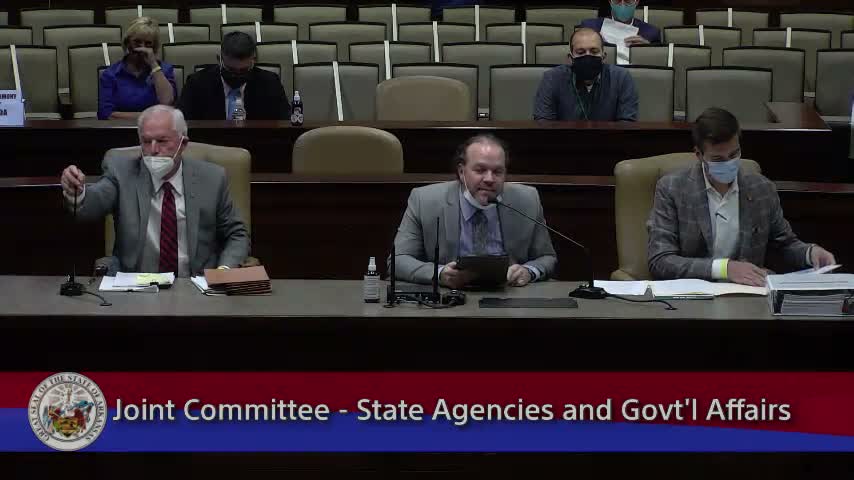
Members of the Arkansas State Agencies & Governmental Affairs committee heard three hours of testimony from reserve‑list cultivation applicants, dispensary and cultivation representatives, state regulators and attorneys about whether the Medical Marijuana Commission should release two remaining cultivation licenses before a July deadline.
Bradley Phillips, who said he represented River Valley Relief during the procurement process, told the committee that the commission’s reserve awards will expire on July 10 and urged legislative oversight to ensure the remaining licenses are handled transparently and fairly. "Affidavits of bias, allegations of ethics, and requests to recuse have all been met with resistance," Phillips said, and he asked legislators to press for answers about recent procedural steps the commission and the attorney general’s office took around a contested application involving Abraham Carpenter.
Charles Singleton of New Day Cultivation quoted a circuit court order and summarized its findings, saying that the court concluded Commissioner Travis Story had "served as attorney for and officer in business entities owned and operated by Jay and Mary True Love" and that Story’s participation "violated the appearance of bias" in the scoring and selection process. Singleton said the commission nevertheless continued to include Story in evaluation and voting on cultivation applications.
Reserve applicants and patient advocates repeatedly framed their request as a patient‑access issue. Storm Nolan of River Valley Relief recounted a family history with opioid addiction and urged policymakers to prioritize patient affordability: "We are the second highest in our country" for retail prices, he said, and argued letting more qualified cultivators operate would increase competition and reduce costs. Pharmacist Nick Landers added that some patients cannot use smoked product and that shortages of specific product types (oils, edibles, gluten‑free formulations) reduce access for medically vulnerable people.
State witnesses said the question of "supply" is the Medical Marijuana Commission’s legal determination. Doorley Chandler, Director of the Alcoholic Beverage Control Division, and an attorney for the commission explained the commission may open selection from its reserve list "upon determining that there are not enough cultivation facilities to supply the dispensaries within the state." Director Chandler said ABC’s seed‑to‑sale tracking system allows agency staff to report plant counts, inventory and sales, but she confirmed the commission did not require monthly poundage reporting by cultivators as a condition of licensing.
Don Parker, president of Delta Medical Cannabis (one of the five originally licensed cultivators), told the committee that three cultivators are already producing and that those producers — plus the soon‑to‑open licensees and dispensary cultivation allowances — would meet current demand. Parker said cultivators have reduced wholesale prices since opening and warned that adopting Oklahoma‑style proliferation of out‑of‑state growers could create enforcement and public‑health problems.
Committee members asked a series of legal and procedural questions: what remedies exist if an administrative body ignores affidavits of bias (the Administrative Procedure Act gives the agency a process to rule on disqualification claims; appeals can go to circuit court), whether the governor can pressure a commissioner to resign, and whether petitioners intended further litigation that could delay the commission’s July deadline. Witnesses said petitioners had not yet filed an appeal to postpone the July date but had not ruled out administrative or court remedies if affidavits were not addressed.
After public and agency testimony, Senator Chesterfield’s motion (presented by Senator Sample) that "it is the will of this committee to recommend to the commission to issue the additional two cultivation licenses before the July cutoff date" was moved, seconded and subjected to a roll call. The motion failed on a roll call with 3 ayes, 1 nay and 4 non‑voting members. The chair adjourned the meeting.
What happens next: the Medical Marijuana Commission retains the statutory authority to determine when and whether to initiate a selection from its reserve list; petitioners retain the option to seek administrative remedies or pursue litigation if they believe the commission has not followed required procedures. The committee’s nonbinding recommendation did not carry the force of law and will not, by itself, change the commission’s pending timelines.
Sources: testimony and exhibits presented to the State Agencies & Governmental Affairs committee; statements read into the record included a quoted circuit court order and internal MMC rules and guidance presented by witnesses.