Get Full Government Meeting Transcripts, Videos, & Alerts Forever!
Get email alerts on the Initiative Process Reform topic
No spam. Unsubscribe anytime.
Arkansas Senate Committee Advances Constitutional Amendment Tightening Ballot-initiative Rules
Summary
A Senate committee voted to advance a constitutional amendment that would raise the legislative vote threshold and county-validation requirements for citizen initiatives, remove the cure period for petition defects, and move submission and challenge deadlines; supporters say it prevents last-minute ballot changes, critics say it leaves fraud and paid-canvasser issues unaddressed.
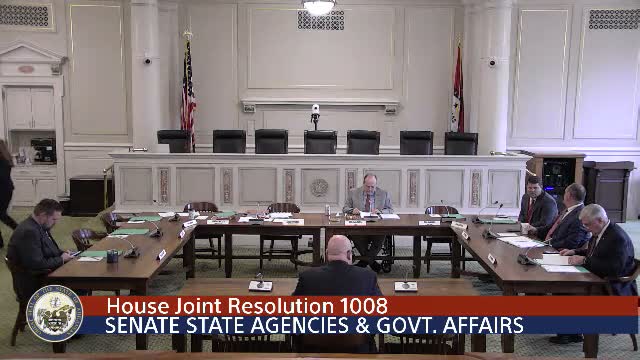
An Arkansas Senate State Agencies & Gov't Affairs committee on Tuesday advanced a proposed constitutional amendment (referred to in testimony as HJR 8 1008) that would tighten the citizen-initiative process by changing vote thresholds, county validation requirements, cure-period rules and filing deadlines.
The amendment would require three-fifths approval in both the House and Senate to adopt constitutional amendments (replacing the current simple-majority standard), increase the number of validating counties required to put an initiative on the ballot from 15 to 45, remove the existing 'cure period' that permitted later fixes to petitions, and move the signature-submission deadline to Jan. 15 with an April 15 deadline for legal challenges, proponents said.
Supporters, including bill sponsor Senator Pitcher, said the date changes are intended to give the Secretary of State and the courts time to resolve disputes well before the November ballot, avoiding last-minute removals. “We went to January 15 for the submittal and...April 15 for the challenges,” the sponsor said in committee testimony, arguing the timetable lets the Supreme Court and election officials resolve challenges before summer.
But opponents told the committee the measure would not address several core problems with the initiative process. Jerry Cox, executive director of Family Council, said the change to require validation in 45 counties creates many more single-county failure points that opponents and litigators can exploit. “If you trip and fall in any one of those 45 counties, then everything you’ve done is out,” Cox said, describing what he called a built-in “gotcha” effect that increases litigation opportunity.
Cox also said the amendment lacks language empowering the legislature to regulate paid canvassers or to require licensing, registration, or other oversight that he said would curb fraud and deceptive practices. “There is not a single word in that measure that will prevent” people from exploiting the process, Cox said, urging lawmakers not to approve the draft as written.
Supporters countered that moving deadlines is a meaningful reform. Randy Zook of the Arkansas State Chamber of Commerce told the committee the most important change in the proposal is the date shift to avoid last-minute Supreme Court decisions that remove measures from the ballot, calling the change the “most significant and important thing” in the proposal.
Committee members also debated whether the General Assembly can regulate the initiative process by statute or whether only a constitutional amendment can change those limits; a senator cited Article 5, section 1 of the Arkansas Constitution during that exchange, noting the constitutional text restricts the legislature’s ability to bind future processes by statute.
After discussion, a member moved to pass the amendment out of committee and the motion received a voice vote. The chair declared, “Ayes have it,” advancing the measure from committee.
The committee did not adopt provisions in this draft that would explicitly grant the legislature new regulatory authority over paid canvassers or add licensing requirements; sponsors and proponents said those items were constrained by constitutional and legal limits discussed during drafting and by counsel in the room.
The amendment will proceed according to the committee’s referral process; proponents described the change as intended to increase certainty about what appears on the ballot, while critics said it favors well-funded campaigns and leaves the risk of page- or signature-level legal challenges in place.
The committee did not set a final calendar date for subsequent floor action in the transcript excerpt; next procedural steps will follow the legislature’s committee-referral and calendar process.