Get Full Government Meeting Transcripts, Videos, & Alerts Forever!
Get email alerts on the Initiative Process topic
No spam. Unsubscribe anytime.
Senate committee hears SJR 4 to tighten Arkansas initiative and amendment rules; critics warn of reduced ballot access
Summary
The Senate State Agencies Committee heard testimony on SJR 4, a joint resolution proposing a 60% passage threshold for constitutional amendments, pre-circulation title review, limits on signature gathering during the cure period, and authority for the legislature to regulate canvassers; opponents said the changes would make it harder for citizens to reach the ballot. No vote was taken.
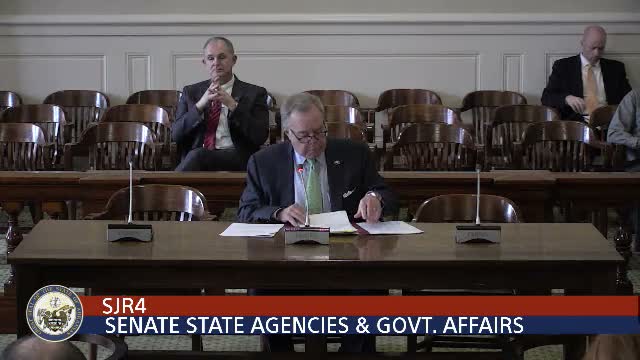
The Senate State Agencies Committee heard public testimony on SJR 4, a proposed joint resolution that would change how Arkansas initiative petitions and constitutional amendments reach the ballot. Sponsors said the bill is intended to "clarify, streamline and protect the citizens of Arkansas," while opponents warned it would make ballot access harder for ordinary citizens.
Committee members and the bill’s sponsor walked the panel through the resolution section by section. Key provisions include requiring statewide initiative petitions to be filed with the Secretary of State by March 1 of the election year; authorizing the General Assembly to set a process to approve the sufficiency of a ballot title before petitions are circulated; raising the required passage threshold for constitutional amendments to 60% while leaving initiated acts at 50% plus one; and restricting the collection of signatures during the period while the Secretary of State or other authority is determining sufficiency (commonly called the "cure period"). The resolution also would give the legislature authority to enact laws regulating volunteer and paid canvassers and reaffirm that the General Assembly may amend the constitution by two-thirds vote of each house.
"SJR 4 is meant to clarify, streamline and protect the citizens of Arkansas," the resolution sponsor said, outlining the stated rationale that deadlines and current procedures are "unattainable, unworkable, unrealistic in today's environment." Supporters told committee members the changes would prevent last-minute challenges that remove measures from the ballot and reduce costly litigation that ends up in the state Supreme Court.
Witnesses testifying against aspects of the resolution argued the same provisions would limit ordinary citizens’ ability to place measures on the ballot. Tom Steele, chairman of Arkansas Term Limits, told the committee there are "too many constitutional amendments," a point he said he shares with proponents, but added that some provisions would unduly restrict participation. He raised concerns that striking the constitutional protection that previously barred laws limiting paid canvassers could be used to prohibit paid circulators and that changes to county-threshold rules and filing windows would make getting on the ballot substantially harder.
Travis Porter, representing himself, said the proposal "reduces by several months the time citizens have to collect signatures" and that prohibiting signature-gathering during the cure period would hamper campaigns that must re-mobilize volunteers after verification. Jerry Cox, director of Family Council, called most of the resolution "very, very good" but said a clause on page 9 of the $3.05 engrossed draft that would explicitly permit the General Assembly to amend or repeal parts of Article V, Section 1 by two-thirds vote was unnecessary and would be a politically sensitive inclusion.
Committee members asked for clarifications about which court would hear challenges and whether challenges would go directly to the Arkansas Supreme Court; the sponsor said the draft establishes original jurisdiction in the Supreme Court for such challenges to save time. Members also requested a comparative "cheat sheet" showing differences between the bill versions; staff agreed to provide the most recently engrossed version before further consideration.
No vote was taken. Committee staff and authors said they would provide revised language and comparative materials; the committee may consider amendments or further drafting changes in later meetings.