Get Full Government Meeting Transcripts, Videos, & Alerts Forever!
Get email alerts on the Equal Rights Amendment topic
No spam. Unsubscribe anytime.
Arkansas Senate committee hears debate on ERA ratification; motion to pass fails for lack of second
Summary
Supporters urged the Senate State Agencies & Governmental Affairs Committee to begin state ratification of the federal Equal Rights Amendment, while opponents warned of vague wording, court challenges and unintended effects; a motion to pass failed for lack of a second and no formal vote on ratification was taken.
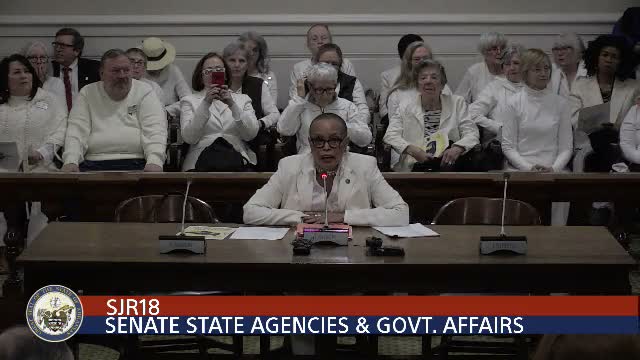
Senator Doris Elliott (District 31) presented Joint Resolution 18 to the Senate State Agencies & Governmental Affairs Committee, urging Arkansas to begin the process to ratify the federal Equal Rights Amendment (ERA) and ‘‘enshrine’’ constitutional protection against discrimination. Elliott described the proposal as paralleling the 19th Amendment and said passage would prevent discrimination being left to a patchwork of statutes that can be repealed.
The hearing opened with lawmakers and members of the public pressing sharply different views on the ERA’s likely legal effects. Joanne Mills, of Little Rock, told the committee she supported the resolution because ‘‘only a federal equal rights amendment can provide US citizens with the highest and broadest level of legal protection against [sex-based] discrimination,’’ and she asked lawmakers to vote for the measure ‘‘for the sake of your grandmothers, your mothers, your children, your grandchildren, and all those women who went before you.’’
Opponents warned of broad, unpredictable consequences. Toni Rose, representing an organization she identified as American Speaks, said the measure’s language is ‘‘vague’’ and argued those ambiguities could be used to overturn laws and policies that currently benefit women. An attorney who identified himself as Attorney Gardner told the committee he had read opinions and reports suggesting the ERA ‘‘will eliminate 800 federal laws, including the elimination of Social Security benefits for wives and widows’’ and that it could affect alimony, child‑support rules and other long‑standing practices.
Elliott and other supporters responded that the ERA would create a clear constitutional standard and that much of the alarm stems from hypothetical or litigated interpretations elsewhere. ‘‘The Equal Rights Amendment is just what it says,’’ Elliott said in her presentation, arguing that the amendment gives constitutional-level protection rather than relying on a ‘‘smorgasbord’’ of statutes that can be repealed or eroded. She urged the committee to start Arkansas’s process so the state could become the next ratifying state.
Committee members queried legal experts about deadlines and rescissions from past ratification attempts. Some senators highlighted conflicting court decisions and the practical difficulties courts might face in assessing whether prior state rescissions or the federal deadline bar a new ratification. One senator noted the congressional research office and recent court filings that complicate the legal picture.
After public comment and sponsor rebuttal, a senator moved to pass the resolution but the motion ‘‘failed for lack of second,’’ and the committee did not take a formal recorded vote to approve the measure that day. Committee members instructed staff and the sponsor to continue the conversation and indicated further procedural steps might follow.
The committee is expected to either revisit the resolution after legal questions are clarified or to leave consideration for a later calendar date; no formal ratification action occurred during this meeting.