Get Full Government Meeting Transcripts, Videos, & Alerts Forever!
Get email alerts on the Elections Petition Reform topic
No spam. Unsubscribe anytime.
Senate committee advances petition-process overhaul, raises signature-fraud penalty to a felony
Summary
A Senate committee voted to report a bill that moves ballot-title certification to the State Board of Election Commissioners and makes intentional, specified signature-collection misconduct a class D felony; witnesses warned the change could increase costs for volunteers and chill grassroots petition drives.
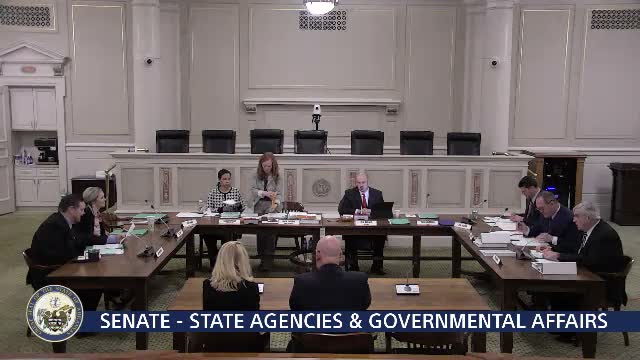
A Senate committee on Thursday voted to report a bill changing how citizen-initiative petitions are handled, including moving certification of ballot titles to the State Board of Election Commissioners and elevating certain intentional signature-collection misconduct from a misdemeanor to a class D felony.
Sponsor Senator Pitch told the committee the measure aligns statute with Article 5, Section 1 of the state constitution and "documents" current collection practices while altering penalties. "We made that a class D felony," the sponsor said, pointing committee members to the bill text (page 1, line 26) and to signature-collection directives later in the draft (page 12and 13).
The bill removes the attorney generals routine, front-end review of ballot titles and establishes that ballot titles and "popular name" certification will be handled by the State Board of Election Commissioners rather than by a separate AG review process. Senator Pitch said the change returns the process to the constitutionally prescribed path: ballot titles go to the election commission for certification and signatures go to the secretary of state for sufficiency review.
Why it matters: supporters said the change restores the constitutional allocation of duties and gives clear statutory authority for the election commission to certify ballot titles; opponents warned it could create new costs and uncertainty for small, volunteer-driven petition campaigns. "You go through all this process, spend a year and a half working. You spend anywhere from 50000 dollars to $200,000," said Melissa Fultz of Drug Policy Education Group, arguing that shifting certification to the commission at the end of the process could void months of work with little chance to fix wording once signatures are collected.
Public testimony and concerns: Jerry Cox, director of Family Council, said the bill "turns the wagon around and puts the cart before the horse," arguing that reinterpreting "certify" to permit substantive review by the election board could advantage well-funded campaigns that can hire lawyers to litigate through the courts. He and other witnesses also warned that raising penalties to a class D felony risks a chilling effect on volunteer canvassers.
Corey Cox, chief of staff for the attorney general, told the panel that the public already can challenge ballot titles in court and that courts "rely on case law" when resolving such disputes; he said the AGs office would defend the state when required.
Sponsorresponse and clarifications: Senator Pitch repeatedly said the bill was intended to "clarify" existing practice, not to change how signatures are collected except to codify assistance when a signer has a disability. He noted the measure was drafted with input from the state chamber, the attorney general, the election commission and the secretary of state. Committee members pressed for clearer statutory language about assisted signing and whether the canvasser should record that assistance on the petition form; staff said an administrative fix by the secretary of state could require such a notation on forms.
Committee action and next steps: Senator Hester moved that the committee report the bill "do pass" as amended; Senator Ballenger seconded and the chair announced, "Ayes have it." The committee recessed after the vote. The committee record shows the vote was taken by voice; a roll-call tally was not included in the hearing transcript.
What remains uncertain: the transcript does not specify the exact statutory citation for the new felony language beyond the bill text references (pages/lines cited during the hearing), whether restitution or other penalties were retained (a restitution section had been removed in an amendment discussed later in the transcript), or a final committee vote tally. The bill will proceed according to the Senates committee-reporting process.