Get Full Government Meeting Transcripts, Videos, & Alerts Forever!
Get email alerts on the Government Reorganization topic
No spam. Unsubscribe anytime.
Senate committee grills details of plan to create Department of Labor and Licensing
Summary
Senators pressed sponsors of House Bill 1305 over appointment authority, board powers and staff transfers as the measure would consolidate many agencies into a new Department of Labor and Licensing. Members sought clearer language on ‘in consultation,’ bonds and where directors would ultimately answer.
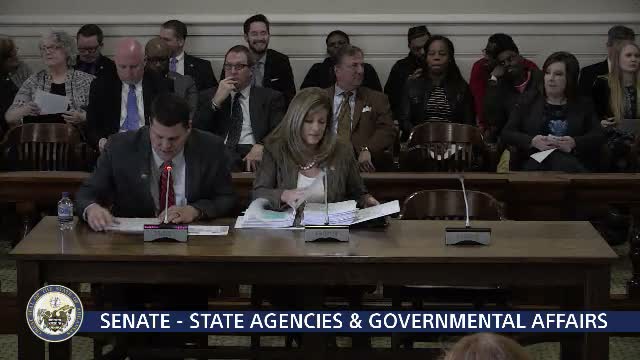
State Senator Barr Hester and Amy Fetcher, chief transformation officer for Governor Hutchinson, presented House Bill 1305 to the Senate State Agencies & Governmental Affairs Committee, proposing a government reorganization that would consolidate many existing agencies into a new Department of Labor and Licensing.
The bill aims to streamline state government — reducing roughly 40 agencies toward a structure of about 15 — and to move several boards, commissions and functions under the proposed new department. Fetcher described the change as part of a broader transformation effort and said the measure will place many occupational licensing boards and executive directors under a single cabinet secretary.
Senators repeatedly raised questions about who would retain hiring and supervisory authority. Senator Hickey asked whether directors would “serve at the pleasure of” both the governor and the secretary; Marty Garrity of the Bureau of Legislative Research read the bill language aloud and said boards would retain hiring authority "in consultation with the secretary," with the board keeping ultimate authority in many instances. Garrity said she interpreted the draft as preserving boards’ existing powers while giving secretaries input.
Multiple members said the phrase “in consultation” is used throughout the transformation bills and asked that the committee define it in the central bill to avoid ambiguity. Senator Hickey and others pressed staff to clarify whether a licensing board’s choice of an executive director could be overruled by the secretary. Garrity and staff agreed to review drafting and to consider inserting a defined consultation standard in the main reorganization draft.
Members also questioned other drafting details: an older requirement that directors provide a $2,000 bond, whether secretaries will also be bonded, and whether employees of certain commissions would become employees of the new department. Senator Hickey asked about inconsistent language on page 64 appearing to replace board authority with secretary appointments for some executive directors; sponsors agreed to check and correct apparent contradictions.
Committee members suggested further cleanups while the bills move forward, including striking archaic phrases such as requirements of "good moral character" and ensuring reports formerly sent to other departments (for example, workers’ compensation statistical reports previously sent to the Department of Insurance) have an appropriate, clearly defined reporting home. Sponsors and staff said they would follow up with the Bureau of Legislative Research and revise language where necessary.
The committee did not record a final roll-call vote on the main reorganization bill during this session; sponsors said a consolidated and refined draft (including confirmation language and final technical edits) was expected by March 8.