Get Full Government Meeting Transcripts, Videos, & Alerts Forever!
Get email alerts on the Transformation General Provisions topic
No spam. Unsubscribe anytime.
Opening language for agency transformation bill lays out 15 'cabinets', raises questions on oversight and finances
Summary
Representatives from the governor's office and the Bureau of Legislative Research presented the enabling provisions of a large reorganization bill that would create 15 departments ('cabinets'), consolidate administrative functions, and authorize technical code revisions; lawmakers pressed for clearer language on oversight, fund transfers, personnel authority, real‑estate title handling, senate confirmation, and financial impact calculations.
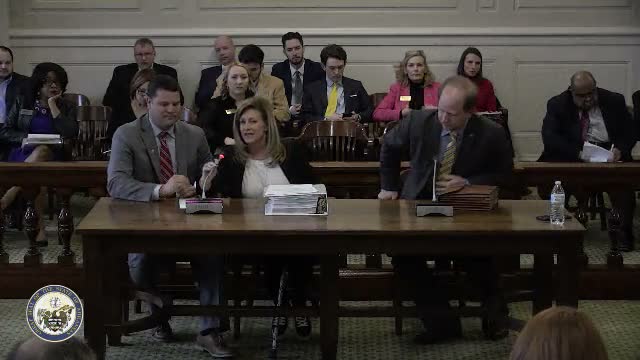
Representatives of the governor's office and legislative research staff presented the opening, enabling language for a broad ‘‘transformation’’ bill that would reorganize state agencies into 15 departments, or "cabinets," each led by a secretary. "This is just the opening language of the bill and will apply to all 15 cabinets," Amy Fetcher, chief transformation officer for the governor's office, told the committee.
Representative Andy Davis, the House sponsor on the Senate panel, outlined the structure: "You'll have 15 individual departments... There is a secretary over each department. Underneath that secretary, you'll have what essentially are today's departments, boards, commissions... Today's directors, agency heads... will be directors of those divisions, and there will be a secretary over them," Davis said. The opening bill contains purpose, definitions, transfer mechanisms, limited code‑revision authority for technical corrections, and an emergency clause.
Members raised multiple technical and oversight questions. Senator Hickey asked whether the definition of "state entity" might unintentionally sweep in non‑executive bodies and whether the General Assembly's authority should be stated as "shall" instead of "may." Marty Garrity of the Bureau of Legislative Research said the bureau requested the code‑revision pathway to avoid unintended transfer mistakes and noted the Code Revision Commission would review technical corrections and notify legislative leaders of changes.
Lawmakers also pressed staff on financial and operational implications. Senators asked how existing real‑property titles would be handled after a transfer; staff said the intent is to leave ownership with the current holder and to tighten language to avoid needless title work. On funding, staff said existing balances and future receipts are intended to follow the entity unless the legislature acts to change that. Members repeatedly requested a financial impact statement and, where possible, the working papers underlying the governor's $15,000,000 savings estimate. "If DFNA had to do some math to get to $15,000,000, I'd like to see the math," Senator Vaughn said; committee staff agreed to work with the Department of Finance and Administration to provide supporting documentation.
The committee discussed personnel authority under the draft language. The bill gives a secretary authority over job descriptions, salaries and benefits, and hiring decisions but allows the secretary to delegate responsibilities to division heads; staff characterized the intent as preserving current operational authority while enabling administrative efficiencies. Senators asked whether secretaries would require Senate confirmation; staff said existing confirmation requirements would remain and confirmation for secretaries has been discussed and could be added in individual bills.
Committee members asked for follow‑up: more precise statutory language, a financial impact statement for each transfer and division, and proof of the assumptions underlying the efficiency estimate. The chair scheduled a special order to continue consideration, with veterans and the Department of Health on the next agenda. The committee did not take a final vote on the transformation language during this session.