
Franklin County residents urge lawmakers to delay Mill Creek Mountain prison site over water, workforce and transparency concerns
Get AI-powered insights, summaries, and transcripts
Subscribe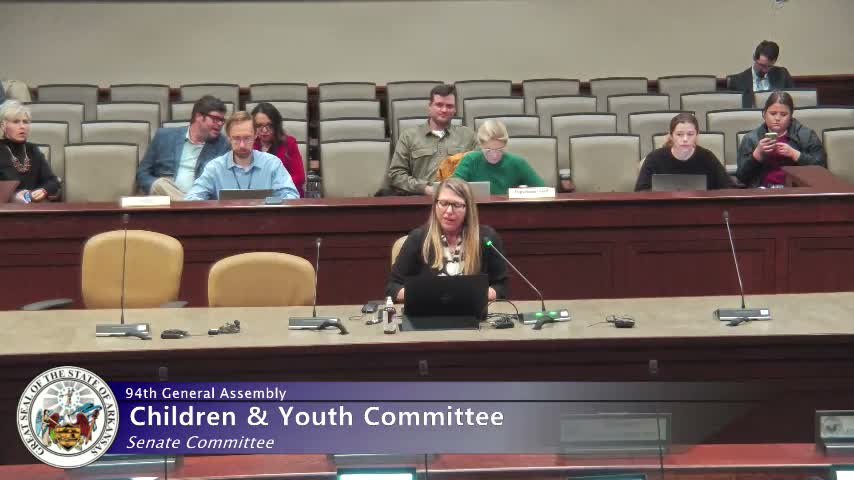
Summary
Residents and Franklin County advocates told the Senate Children and Youth Committee the Mill Creek Mountain site is poorly suited for a proposed 3,000-bed prison, citing an inadequate site study, water and emergency-services limits, workforce shortfalls and disputed FOIA records; lawmakers asked for follow-ups, and no vote was taken.
NATALIE CADENA, a representative of the Franklin County and River Valley Coalition, told the Senate Children and Youth Committee on Friday that her group is "resolutely opposed" to building a prison on Mill Creek Mountain and urged lawmakers to delay further spending until a full site assessment is completed.
"We would not be standing here today if we did not fully believe that building a prison on Mill Creek Mountain is bad for all Arkansans," Cadena said in a prepared presentation that included maps, cost estimates and local testimony. She told the committee the state paid nearly $3,000,000 for the parcel and that the site's karst geology, thin labor shed and limited emergency-services capacity make it ill-suited for a facility of the scale being discussed.
Cadena argued the site study relied on by officials was incomplete and that the engineering and water analyses did not reflect local conditions. She said the presentation shows about 200 of roughly 600 homes lie within a five-mile radius of the proposed site and warned that construction on karst topography would raise excavation and foundation costs.
Adam Watson, chair of the coalition's legal and legislative committee, told lawmakers that multiple FOIA requests to state agencies were delayed or returned with incomplete information. "FOIA requests are either being flatly denied or answered in a way that we know the answers are misleading because we have the documents," Watson told the committee, and he said some agency replies stated that responsive communications did not exist even though the coalition possesses records that contradict that claim.
Lawmakers pressed presenters on costs and timing. Committee members compared recent national per-bed figures and questioned a widely reported $470 million estimate for a 3,000-bed project, noting other projects have higher per-bed costs amid elevated materials and labor prices. Senator Stubblefield said the state should be transparent about who knew what and when and warned that residents in the affected county had been kept in the dark.
Presenters highlighted several quantifiable concerns: they reported a 35-minute commute labor-shed population of about 30,800 and cited a local unemployment/ vacancy snapshot that the coalition presented as roughly 3,000 unemployed and 6,500 job openings in the broader labor market; they also estimated supporting emergency-services capital and staffing could cost millions more than site documents account for. Cadena provided example calculations that estimate dirt-moving and rock-removal expenses could push site-preparation costs well into the tens of millions.
Watson said that, according to communications from ADFA's counsel, ADFA intends to retain title to the land and grant operating authority to whichever intergovernmental agency will operate the facility rather than transfer title directly to the Department of Corrections — a step that could change which legislative approvals are required. Committee members asked staff to verify whether a legislative vote on a title transfer or on any operational lease or agreement will be required.
The committee did not take any formal action. Chairpersons asked staff to draft follow-up questions for the Department of Corrections, the Board of Corrections, ADFA and other relevant offices about FOIA responses, title and transfer steps, water capacity and emergency-services needs. The committee said it plans more meetings before the legislative session begins.
The presentation and subsequent questioning are part of an ongoing review by lawmakers and community members about the project and its site selection; presenters said they would make their materials available online and provide additional documents to committee staff on request.