Get Full Government Meeting Transcripts, Videos, & Alerts Forever!
Get email alerts on the Wind Energy topic
No spam. Unsubscribe anytime.
Senate committee hears industry briefing on Arkansas wind projects, grid needs and local tax deals
Summary
Industry representatives told a Senate committee that improved turbine technology and looming coal-plant retirements are driving new wind projects in eastern Arkansas, described a Cross County 135 MW project under construction, and outlined tax-in-lieu agreements, wildlife studies, and backup-generation options for periods of low wind.
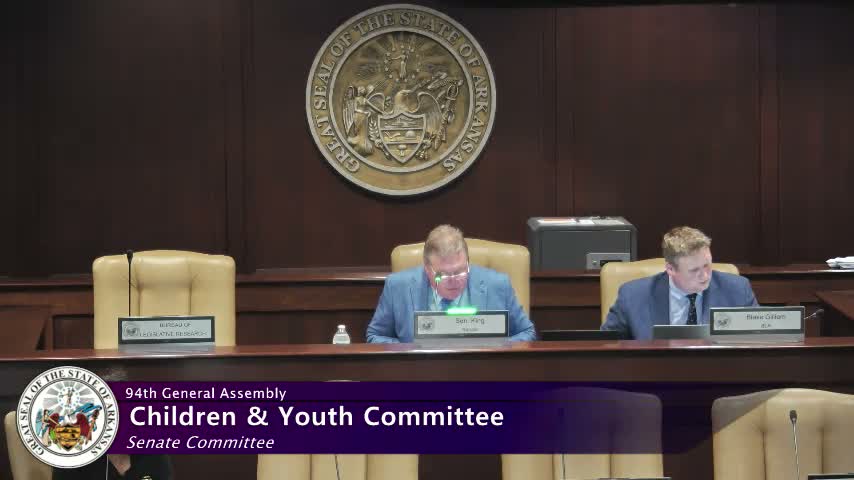
Industry representatives briefed the Children and Youth Committee on the emergence of utility-scale wind development in Arkansas, the companies’ plans for local projects and agreements, and questions from senators about reliability, wildlife and school funding.
Simon Mahan, executive director of the Southern Renewable Energy Association, told the committee that Arkansas sits across two regional grid operators — the Midcontinent Independent System Operator (MISO) and the Southwest Power Pool (SPP) — and that improvements in turbine height and blade length are making wind projects viable in parts of the state. "When the wind does blow, it's a very good low cost energy resource. It is reliable," Mahan said, adding that grid operators forecast wind output and back it up with natural gas or coal when needed.
Brad Lila, vice president of development for Cordelio Power, outlined Cordelio’s pipeline in Arkansas, including a 135-megawatt Cross County project under construction. Lila said Cordelio is financed by a Canadian pension fund and described local agreements negotiated with Cross County officials. "We agreed to share 50% of that savings with the county," he said, adding that the company expects to remit roughly $400,000 a year under the pilot payment-in-lieu-of-taxes (PILOT) arrangement while also paying about $489,000 in other taxes.
Senators pressed presenters on several local impacts. On reliability, Mahan and Lila said utilities are using a mix of short-term capacity contracts, batteries and combustion-turbine natural-gas units to cover periods when renewable output is low. Mahan described generator interconnection queues and said new dispatchable plants can take years to site and build; that process, he said, often leads utilities to rely temporarily on short-term capacity in regional markets.
On wildlife and environment, Lila described multi-year bird and bat studies, mapping of eagle nests and coordination with the U.S. Fish and Wildlife Service. He acknowledged earlier-era projects had greater raptor impacts at places such as Altamont Pass but said modern siting and mitigation reduce those risks. "We hire a third-party firm to identify every eagle nest within a project area and several miles outside," he said.
On community issues, senators asked about turbine foundations, noise setbacks, ice throw and fire risk. Lila said typical foundations in Cross County are roughly 12–13 feet deep and that developers target a noise threshold of about 50 decibels at nearby residences, with practical setbacks commonly in the 1,500-foot range. On decommissioning, he said counties and developers commission third-party studies to set bond amounts and that aboveground equipment is removed while some buried cabling is often left in place for practical reasons.
On financing and federal incentives, presenters said most projects use tax-equity structures and federal credits — production tax credits (PTC) and investment tax credits (ITC) — to lower effective costs. Lila and Mahan emphasized developers do not receive direct federal checks; rather, tax credits reduce investor tax liabilities or are monetized through investors.
Chair and committee staff said attorneys will follow up with county officials to clarify how PILOT agreements interact with state school funding formulas. The committee adjourned after agreeing to share contact information and receive further details on taxation and local revenue implications.