Get Full Government Meeting Transcripts, Videos, & Alerts Forever!
Get email alerts on the Cacd Quarterly Report topic
No spam. Unsubscribe anytime.
Arkansas State Police report 4,168 accepted hotline calls and 29% substantiation rate in quarterly CACD update
Summary
Major Drew told the Children and Youth Committee the Crimes Against Children Division received 15,861 hotline calls in April–June 2024, accepted 8,168 for further review, and substantiated 419 of 1,504 open cases (29% substantiation); staffing shortfalls at the hotline (25 of 35 operator positions filled) are straining capacity.
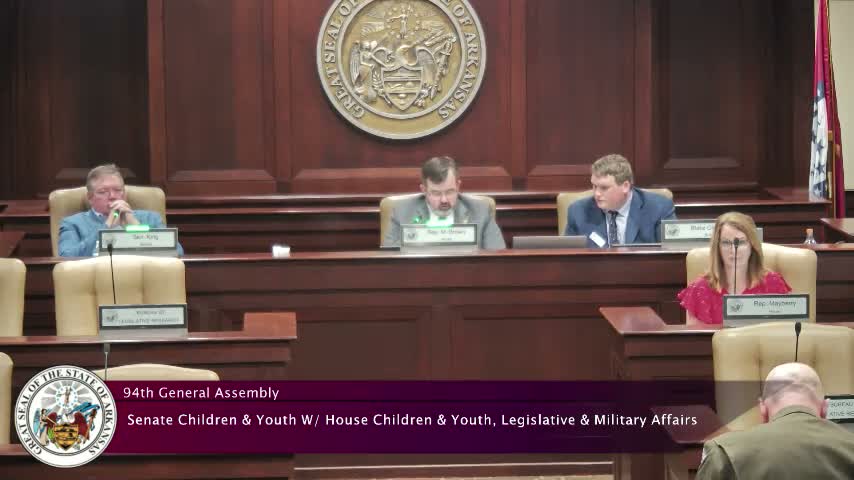
Major Drew of the Arkansas State Police presented the quarterly Crimes Against Children Division (CACD) oversight report to the Senate Children and Youth Committee on Aug. 26, summarizing hotline volume, case outcomes and staffing pressures.
Drew said CACD received 15,861 hotline calls during the April–June 2024 quarter and accepted 8,168 for further review. During that period CACD had 1,504 open cases and closed 1,439; 419 were found to be substantiated, a 29% substantiation rate. Of 758 matters submitted for prosecutorial review, Drew reported 545 charges were filed, 154 were pending and 59 were declined.
"If it's something that would meet the standards of maltreatment, it wouldn't make it to investigations. They would be screened out there at the hotline," Drew told the committee, describing the division's intake and triage role.
Members questioned whether CACD data could be filtered to identify reports tied to a particular facility; Drew said the case management system is organized by alleged offender and victim, and isolating reports by facility would require a manual search. Lawmakers also pressed Drew on mandated reporter training and on hotline staffing; he said educators typically receive annual training and that CACD offers training programs, but the hotline has only 25 of 35 operator positions filled and experiences frequent turnover.
Why it matters: High call volumes and operator vacancies create triage challenges and increase workload for investigators, and legislators asked the division to consider whether system changes could make facility‑level queries or better support mandated reporters. Drew offered to take questions and follow up where staff could provide more granular data.
Next step: Committee members raised follow‑up requests, including whether reports originating from the Youth Challenge site could be identified in CACD records; Major Drew said that would require manual review and offered to report back.
The committee adjourned after completing the CACD presentation and questions.