Get AI Briefings, Transcripts & Alerts on Local & National Government Meetings — Forever.
Arkansas Department of Military ends Youth Challenge program after staffing, safety and oversight problems
Loading...
Summary
Department leaders told the Senate Children and Youth Committee they closed the Arkansas Youth Challenge program because persistent cadre vacancies, repeated staff misconduct investigations and safety incidents made it impossible to guarantee youth safety; Arkansas will place current students in other states and cover the state match for those placements.
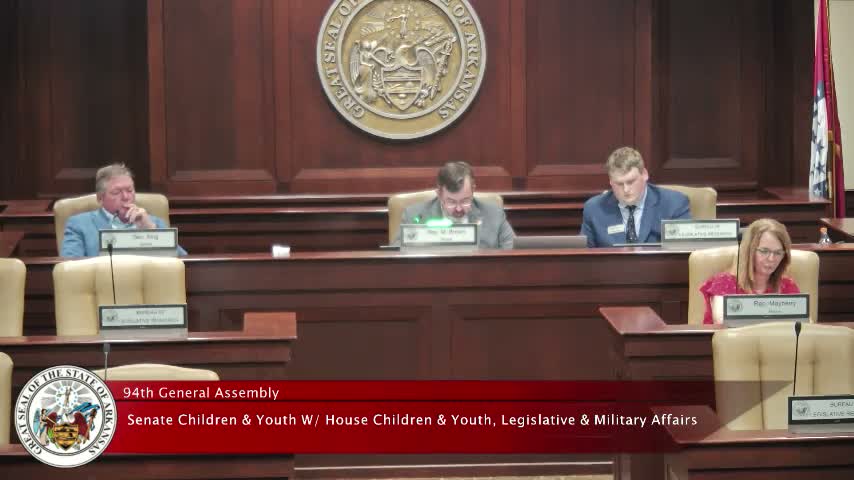
Arkansas Department of Military leaders told the Senate Children and Youth Committee on Aug. 26 that they have decided to curtail the state’s National Guard Youth Challenge program after long‑running staffing shortages, supervisory failures and a series of investigations into staff misconduct.
Jeff Wood, chief of staff for the Arkansas Department of Military, said the federal Youth Challenge program — a residential initiative for high‑school dropouts — is largely federally funded but requires a state match and strict staffing ratios. Wood told the committee the department could not recruit or retain enough qualified cadre to maintain safe operations and cited multiple administrative investigations and an outside audit that revealed leadership and reporting problems.
"We couldn't recruit and retain our cadre," Wood said. "We couldn't guarantee the safety of it. If we can't do that to the parents of those kids, then we just needed to close the program." He said the program operated in Arkansas for about 31 years and that roughly 4,600 cadets graduated during that time.
Why it matters: Committee members pressed for specifics about the allegations and the department’s follow‑up. Wood described findings that included six cadets who tested positive for marijuana, allegations that cadre sold drugs (which the internal investigation found unsubstantiated), incidents of inappropriate relationships or communications between cadre and cadets, and a barracks electrical fire that students helped extinguish. Some staff were terminated following administrative investigations; at least one case referred to law enforcement did not result in criminal charges, Wood said.
Wood said the department also faced an acute labor problem: average cadre tenure was cited as about five months, with many employees leaving within 90 days. Arkansas historically paid cadre in the high‑$20,000s to low‑$30,000s range in the years discussed, below what some other states offered, and Wood said the combination of low pay, low minimum hiring qualifications and post‑COVID labor market dynamics made recruitment especially difficult. He cited national RAND and GAO reports showing similar staffing pressures in other states.
On placements and costs: Wood told the committee the state had secured placements for students scheduled to start this summer with programs in Kentucky and Louisiana and that Arkansas would cover the state's portion of those students' costs for the current classes and assist with transportation. He estimated the state share at roughly $6,200 per student.
What the department asked of legislators: Wood said the immediate focus is closing the program safely and supporting affected families; he told lawmakers that federal rules mean a state typically must wait a year to 18 months after federal funding is cut before reapplying to operate a Youth Challenge site again, and that any reopening would require a detailed corrective plan.
Committee requests and next steps: Members asked for historical graduation and enrollment data prior to 2019 to assess longer trends; staff agreed to provide the requested records. Several members praised the department for transparency and asked for follow‑up before the next session.
The decision to curtail the program was announced to the committee; it was not a committee vote but an administrative decision by the Department of Military.