Lifetime Citizen Portal Access — AI Briefings, Alerts & Unlimited Follows
Senate panel hears experts warn of national-security risks from foreign-linked bitcoin mining
Loading...
Summary
Experts told the Senate Children and Youth Committee that Bitcoin mining operations can be opaque, often depend on large power contracts, and that foreign-linked ownership and concentrated "hash power" raise national-security concerns; witnesses urged state-level due diligence and clearer reporting requirements.
Senator King heard from two outside experts Dec. 5 about how Bitcoin mining operations can pose national-security and local oversight challenges.
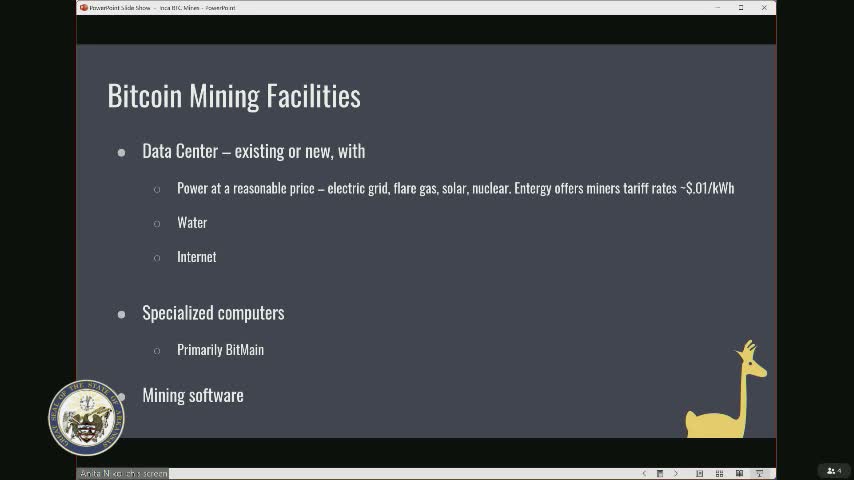
Anita Nikolic, a University of Illinois researcher who leads a DARPA-funded mapping project of U.S. Bitcoin mines, told the committee that mining sites typically require land or a building, low-cost power and internet connectivity and that many U.S. mines are clustered in a limited number of states. "There are facilities, as far as we could find, in 21 states," Nikolic said, and "there are no federal reporting requirements of any type" for mining facilities. She noted large facilities under construction, including one in Abilene, Texas, that will measure in the gigawatts.
The nut of Nikolic's argument was that ownership and occupant structures for mines are often opaque. She described land purchases and corporate registrations routed through complex company networks, sometimes with offshore hubs, and cited recent high-profile transactions involving YZY Capital and a Wyoming project tied to Bison Blockchain. Nikolic said Microsoft raised concerns to the Committee on Foreign Investment in the United States (CFIUS) about a site near Department of Defense-related computing facilities and that a White House executive order in May 2024 required divestiture of one parcel within six months.
Adam Zarasinski, CEO of Inca Digital, said the industry's reliance on specialized hardware manufactured largely by Bitmain and the centralization of "hash power" can give owners practical influence over parts of the Bitcoin ecosystem. "If you want to understand where miners locate, power is the key," he said. Both witnesses recommended stronger state-level oversight of large power contracts and clearer mechanisms for identifying who actually occupies or operates within data centers that may be used for mining.
They also highlighted cybersecurity and supply-chain concerns: Nikolic said shipments of Bitmain equipment have increased sharply in recent years and referenced a reported firmware backdoor in Bitmain machines. The witnesses recommended that states consider targeted transparency or reporting requirements and that regulators clarify which federal rules apply so compliant firms can follow them.
The committee did not take formal action. Senator King said the committee will follow up with the witnesses for further guidance.
The hearing illustrated tensions between economic development and security: mining brings investment and jobs tied to power contracts, but the witnesses said the combined effect of opaque ownership, concentrated hardware suppliers and proximity to sensitive sites requires careful review by state and federal authorities.