Get Full Government Meeting Transcripts, Videos, & Alerts Forever!
Get email alerts on the Human Trafficking Ncmec topic
No spam. Unsubscribe anytime.
National Center outlines trafficking trends, free tools and Arkansas case data
Summary
The National Center for Missing and Exploited Children told the Senate Children and Youth Committee that runaway cases are a key at-risk group, that 1 in 6 runaway reports in 2021 were likely trafficking victims, and that NCMEC provides analytic leads, a 24/7 CyberTipline and free trainings for Arkansas stakeholders.
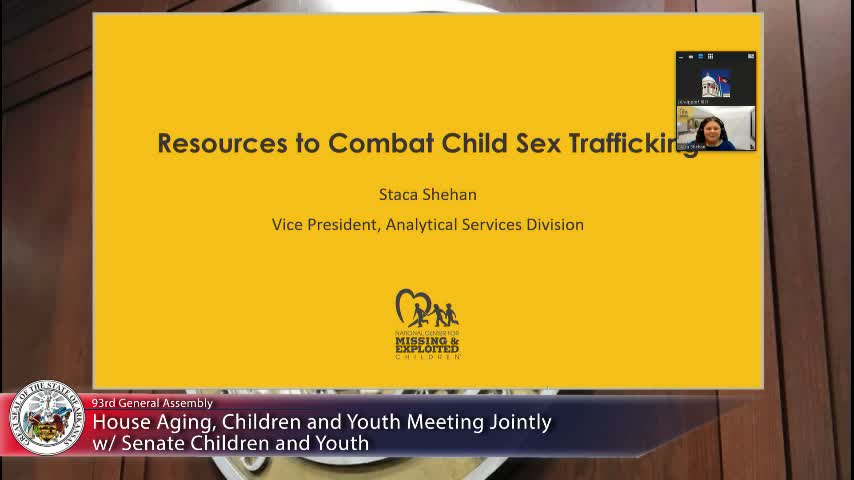
Stacey Sheehan, vice president of an analytical division at the National Center for Missing and Exploited Children, told the Senate Children and Youth Committee that missing-child reports remain a critical way to identify potential trafficking victims and that the center’s analytic capacity and public resources are available to Arkansas law enforcement and child-welfare partners.
Sheehan emphasized that not every missing child is a trafficking victim but said the numbers show vulnerability: in 2021 the National Center received more than 25,000 missing-child reports and, among children who ran away, about 1 in 6 were likely victims of child trafficking. She highlighted demographic patterns in those cases, saying nearly 80% of likely trafficking victims were 15–17 years old and that almost 66% were children of color or indigenous — and she cautioned male victimization is likely underreported.
On Arkansas-specific data Sheehan said the National Center received 252 missing-child reports from Arkansas in 2021, about 185 of which were missing from care, and 31 cases were listed as active on 12/31/2021 (a year-end snapshot that can include recent recoveries).
Sheehan described the CyberTipline, an online reporting portal and a 24/7 call center that reviews and prioritizes tips for immediate risk. She said NCMEC analysts combine donated public-record databases and open-source information to generate leads for law enforcement, and gave a composite example of how phone numbers, social-media posts and online ads can link multiple missing-child reports across jurisdictions and produce actionable investigative leads.
Sheehan also outlined victim-centered recovery services: a child-trafficking recovery services team coordinates directly with child-welfare agencies when children missing from care are believed to be trafficking victims, and regional specialists (Arkansas is in Region 3) help develop safety plans and longer-term, trauma-informed support to increase the chance a child remains in care and engages with services.
Finally, Sheehan reviewed NCMEC’s free training resources: a three-module “Introduction to Child Trafficking” for broad audiences, a 201-level investigative course for law enforcement, and a planned child-welfare training series to be released later this year. She encouraged committee members to consult missingkids.org and to direct follow-up questions to staff for additional Arkansas-specific data.
The committee thanked Sheehan and said staff would circulate the presentation to members.