Get Full Government Meeting Transcripts, Videos, & Alerts Forever!
Get email alerts on the Family Preservation Services topic
No spam. Unsubscribe anytime.
DHS director lays out hotline-to-court process and statewide child-welfare metrics
Summary
Director Misha Martin presented a Family Preservation Services report describing how hotline calls are triaged into CRIS, response timelines (24/72 hours), the 45-day investigation window, OAH appeal rights, and statewide metrics including 28,645 screened-in calls, an 84% initiation rate and a 21% substantiation rate for DCFS investigations.
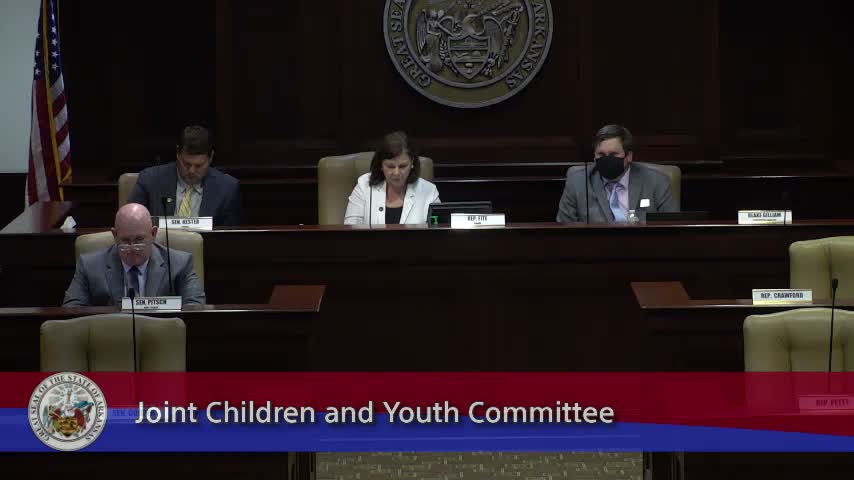
Arkansas Department of Human Services Director Misha Martin on June 10 walked the Senate Children and Youth Committee through a detailed process map tying the child-abuse hotline to investigation, protective services and court action, and presented county-level Family Preservation Services data for calendar year 2019.
“The process really begins for both DCFS and CACD with a call to the to the child abuse hotline,” Martin said, describing how intake staff use the child maltreatment act and division policies to screen reports. Cases are assigned via the MOU and CRIS case-management system to CACD, DCFS investigation, or DCFS differential response. “Both CACD, the hotline, as well as DCFS uses the same case management system, CRIS,” she said.
Martin told the committee investigators must assess safety and determine whether maltreatment occurred; when a child faces immediate danger, DCFS places the child into foster care and initiates a circuit-court petition. She explained the 45-day investigative window and that a “true finding” (preponderance of evidence) triggers certified notice to the alleged offender, who has 30 days to appeal to the Office of Appeals and Hearings (OAH) before being placed on the central registry.
Martin emphasized that most calls do not result in foster care: "We serve more children in home than we do in foster care," she said, and noted DCFS tries to keep children safely at home through services when possible.
On metrics, Martin reported the number of screened-in calls was 28,645 (a slight decrease), an 84% initiation rate for seeing victim children, and a 21% substantiation rate for DCFS investigations. She said reoccurrence of maltreatment measured at 6% (below the national standard) and cited improvements in placing children closer to home and with siblings. Martin pointed to county-level variation in placement stability and singled out Areas 4, 6, 8 and 10 as having higher movement rates.
During questions, Martin acknowledged concerns about protection plans, saying the division has increased oversight, partnered with the National Council on Crime and Delinquency (NCCD) for a safety-risk reassessment, and requires regional program-administrator approval of protection plans to ensure quality. She also said workforce recruitment and retention remain a challenge in some areas; Area 1’s lower in‑home-visit rates reflect difficulty finding and keeping staff.
Representative Wooten asked about qualifications; Martin said family service workers (the caseworker classification) require a bachelor’s degree and the division has broadened acceptable degrees to improve recruitment, while providing targeted training.
The committee thanked Martin for the presentation and was directed to the report appendix for county-by-county breakdowns.